
期刊文章
过刊浏览
- Volumes 108-119 (2025)
-
Volumes 96-107 (2025)
-
Volume 107
Pages 1-376 (December 2025)
-
Volume 106
Pages 1-336 (November 2025)
-
Volume 105
Pages 1-356 (October 2025)
-
Volume 104
Pages 1-332 (September 2025)
-
Volume 103
Pages 1-314 (August 2025)
-
Volume 102
Pages 1-276 (July 2025)
-
Volume 101
Pages 1-166 (June 2025)
-
Volume 100
Pages 1-256 (May 2025)
-
Volume 99
Pages 1-242 (April 2025)
-
Volume 98
Pages 1-288 (March 2025)
-
Volume 97
Pages 1-256 (February 2025)
-
Volume 96
Pages 1-340 (January 2025)
-
Volume 107
-
Volumes 84-95 (2024)
-
Volume 95
Pages 1-392 (December 2024)
-
Volume 94
Pages 1-400 (November 2024)
-
Volume 93
Pages 1-376 (October 2024)
-
Volume 92
Pages 1-316 (September 2024)
-
Volume 91
Pages 1-378 (August 2024)
-
Volume 90
Pages 1-580 (July 2024)
-
Volume 89
Pages 1-278 (June 2024)
-
Volume 88
Pages 1-350 (May 2024)
-
Volume 87
Pages 1-338 (April 2024)
-
Volume 86
Pages 1-312 (March 2024)
-
Volume 85
Pages 1-334 (February 2024)
-
Volume 84
Pages 1-308 (January 2024)
-
Volume 95
-
Volumes 72-83 (2023)
-
Volume 83
Pages 1-258 (December 2023)
-
Volume 82
Pages 1-204 (November 2023)
-
Volume 81
Pages 1-188 (October 2023)
-
Volume 80
Pages 1-202 (September 2023)
-
Volume 79
Pages 1-172 (August 2023)
-
Volume 78
Pages 1-146 (July 2023)
-
Volume 77
Pages 1-152 (June 2023)
-
Volume 76
Pages 1-176 (May 2023)
-
Volume 75
Pages 1-228 (April 2023)
-
Volume 74
Pages 1-200 (March 2023)
-
Volume 73
Pages 1-138 (February 2023)
-
Volume 72
Pages 1-144 (January 2023)
-
Volume 83
-
Volumes 60-71 (2022)
-
Volume 71
Pages 1-108 (December 2022)
-
Volume 70
Pages 1-106 (November 2022)
-
Volume 69
Pages 1-122 (October 2022)
-
Volume 68
Pages 1-124 (September 2022)
-
Volume 67
Pages 1-102 (August 2022)
-
Volume 66
Pages 1-112 (July 2022)
-
Volume 65
Pages 1-138 (June 2022)
-
Volume 64
Pages 1-186 (May 2022)
-
Volume 63
Pages 1-124 (April 2022)
-
Volume 62
Pages 1-104 (March 2022)
-
Volume 61
Pages 1-120 (February 2022)
-
Volume 60
Pages 1-124 (January 2022)
-
Volume 71
- Volumes 54-59 (2021)
- Volumes 48-53 (2020)
- Volumes 42-47 (2019)
- Volumes 36-41 (2018)
- Volumes 30-35 (2017)
- Volumes 24-29 (2016)
- Volumes 18-23 (2015)
- Volumes 12-17 (2014)
- Volume 11 (2013)
- Volume 10 (2012)
- Volume 9 (2011)
- Volume 8 (2010)
- Volume 7 (2009)
- Volume 6 (2008)
- Volume 5 (2007)
- Volume 4 (2006)
- Volume 3 (2005)
- Volume 2 (2004)
- Volume 1 (2003)
Volume 117
Hydraulic transport of coarse particles in a slurry shield circulation system with swirl induction pipes: A CFD-DEM study (Open Access)
Guozhen Li a b, Zheng Wang a b, Nicholas J. Miles b c, Philip Hall a b *
a Department of Chemical and Environmental Engineering, Faculty of Science and Engineering, University of Nottingham, Ningbo, 315100, China
b Nottingham Ningbo China Beacons of Excellence Research and Innovation Institute, Ningbo, 315100, China
c Faculty of Engineering, University of Nottingham, University Park, Nottingham NG7 2RD, UK
10.1016/j.partic.2026.07.016
Volume 117,
October 2026,
Pages 219-234
Received 19 April 2026, Revised 15 July 2026, Accepted 27 July 2026, Available online 28 July 2026, Version of Record 6 August 2026.
E-mail:
Philip.Hall@nottingham.edu.cn
Highlights
• A novel swirl pipe was applied to slurry shield for enhanced particle transport.
• Particle transport characteristics and enhancement were evaluated by CFD-DEM model.
• Better particle suspension and less sedimentation were predicted with swirl pipes.
• The potential to transport with lower velocity was demonstrated thus saving energy.
Abstract
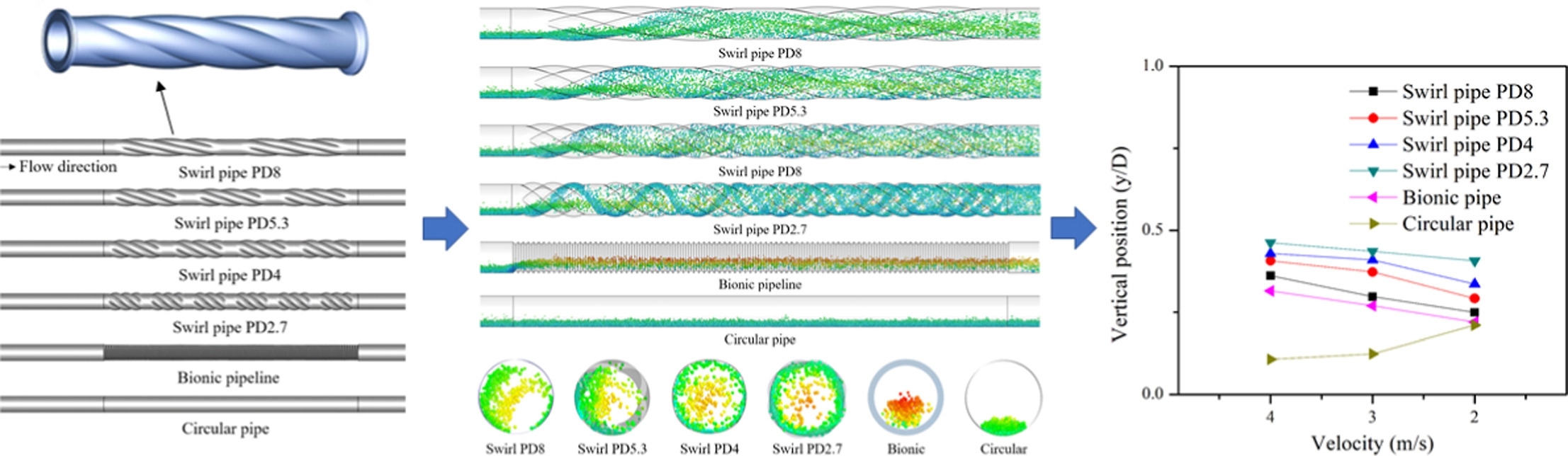
In underground tunnelling, it is essential to prevent sedimentation and clogging of the slurry circulation pipelines in slurry shields, as otherwise a series of consequences will occur that eventually lead to failure of the tunnel working face. The present study proposes a method to induce swirling motions in the slurry-stone transport pipeline using swirl induction pipes to sweep the accumulated stones at the pipe bottom into the mainstream and sustain their suspension, thereby minimizing the risk of clogging. We established a CFD-DEM (Computational Fluid-Discrete Element Method) coupled simulation, together with an Archard wear model, to predict the complex slurry-stone interaction, the inter-particle and particle-wall interactions during the transport of excavated coarse stones in non-Newtonian bentonite slurry within the circulation system. We validated the model against available experimental data and employed the validated model to evaluate the enhancement of hydraulic transportation by swirl pipes with various pitch-to-diameter (PD) ratios at different slurry inlet velocities, in terms of slurry flow pattern, particle distribution, slip factor, particle accumulation rate, pressure loss and pipeline wear. Special attention was paid to the potential of swirl pipes to operate at a fraction of the conveying velocity required for conventional circular pipe systems without the risk of clogging. The study demonstrates that a suitable fraction of the conventional conveying velocity and an optimal PD ratio for the swirl pipe can be achieved to reduce pumping energy, pressure loss and wear, thereby saving operation and maintenance costs.
Graphical abstract
Keywords
Hydraulic transport; Swirl flow; CFD-DEM; Erosion wear; Slurry shield
文章导读