
期刊文章
过刊浏览
- Volumes 108-119 (2025)
-
Volumes 96-107 (2025)
-
Volume 107
Pages 1-376 (December 2025)
-
Volume 106
Pages 1-336 (November 2025)
-
Volume 105
Pages 1-356 (October 2025)
-
Volume 104
Pages 1-332 (September 2025)
-
Volume 103
Pages 1-314 (August 2025)
-
Volume 102
Pages 1-276 (July 2025)
-
Volume 101
Pages 1-166 (June 2025)
-
Volume 100
Pages 1-256 (May 2025)
-
Volume 99
Pages 1-242 (April 2025)
-
Volume 98
Pages 1-288 (March 2025)
-
Volume 97
Pages 1-256 (February 2025)
-
Volume 96
Pages 1-340 (January 2025)
-
Volume 107
-
Volumes 84-95 (2024)
-
Volume 95
Pages 1-392 (December 2024)
-
Volume 94
Pages 1-400 (November 2024)
-
Volume 93
Pages 1-376 (October 2024)
-
Volume 92
Pages 1-316 (September 2024)
-
Volume 91
Pages 1-378 (August 2024)
-
Volume 90
Pages 1-580 (July 2024)
-
Volume 89
Pages 1-278 (June 2024)
-
Volume 88
Pages 1-350 (May 2024)
-
Volume 87
Pages 1-338 (April 2024)
-
Volume 86
Pages 1-312 (March 2024)
-
Volume 85
Pages 1-334 (February 2024)
-
Volume 84
Pages 1-308 (January 2024)
-
Volume 95
-
Volumes 72-83 (2023)
-
Volume 83
Pages 1-258 (December 2023)
-
Volume 82
Pages 1-204 (November 2023)
-
Volume 81
Pages 1-188 (October 2023)
-
Volume 80
Pages 1-202 (September 2023)
-
Volume 79
Pages 1-172 (August 2023)
-
Volume 78
Pages 1-146 (July 2023)
-
Volume 77
Pages 1-152 (June 2023)
-
Volume 76
Pages 1-176 (May 2023)
-
Volume 75
Pages 1-228 (April 2023)
-
Volume 74
Pages 1-200 (March 2023)
-
Volume 73
Pages 1-138 (February 2023)
-
Volume 72
Pages 1-144 (January 2023)
-
Volume 83
-
Volumes 60-71 (2022)
-
Volume 71
Pages 1-108 (December 2022)
-
Volume 70
Pages 1-106 (November 2022)
-
Volume 69
Pages 1-122 (October 2022)
-
Volume 68
Pages 1-124 (September 2022)
-
Volume 67
Pages 1-102 (August 2022)
-
Volume 66
Pages 1-112 (July 2022)
-
Volume 65
Pages 1-138 (June 2022)
-
Volume 64
Pages 1-186 (May 2022)
-
Volume 63
Pages 1-124 (April 2022)
-
Volume 62
Pages 1-104 (March 2022)
-
Volume 61
Pages 1-120 (February 2022)
-
Volume 60
Pages 1-124 (January 2022)
-
Volume 71
- Volumes 54-59 (2021)
- Volumes 48-53 (2020)
- Volumes 42-47 (2019)
- Volumes 36-41 (2018)
- Volumes 30-35 (2017)
- Volumes 24-29 (2016)
- Volumes 18-23 (2015)
- Volumes 12-17 (2014)
- Volume 11 (2013)
- Volume 10 (2012)
- Volume 9 (2011)
- Volume 8 (2010)
- Volume 7 (2009)
- Volume 6 (2008)
- Volume 5 (2007)
- Volume 4 (2006)
- Volume 3 (2005)
- Volume 2 (2004)
- Volume 1 (2003)
Volume 117
Pore-to-reactor CFD-DEM modeling: How intraparticle diffusion limitation affects crotonaldehyde selectivity over Zr-BEA zeolite
Zhongfeng Geng a b c, Zhenhan Wang a b c, Yu Zhang a b c, He Dong a b c *
a Key Laboratory for Green Chemical Technology of Ministry of Education, R&D Center for Petrochemical Technology, Tianjin University, Tianjin, 300072, China
b Zhejiang Institute of Tianjin University, Ningbo, 315201, China
c State Key Laboratory of Engines, Tianjin University, Tianjin, 300072, China
10.1016/j.partic.2026.06.041
Volume 117,
October 2026,
Pages 235-248
Received 10 April 2026, Revised 24 June 2026, Accepted 29 June 2026, Available online 10 July 2026, Version of Record 6 August 2026.
E-mail:
donghe@tju.edu.cn
Highlights
• Micron-scale model of Zr-BEA zeolite obtaining effective diffusion coefficients of each component.
• Intraparticle reaction-diffusion model analyzing the effect of particle shape and size.
• Correlation model of temperature, partial pressure and internal diffusion effectiveness factor.
• Apparent kinetic equations considering diffusion restriction.
• Effect of process conditions on reaction rate and selectivity.
Abstract
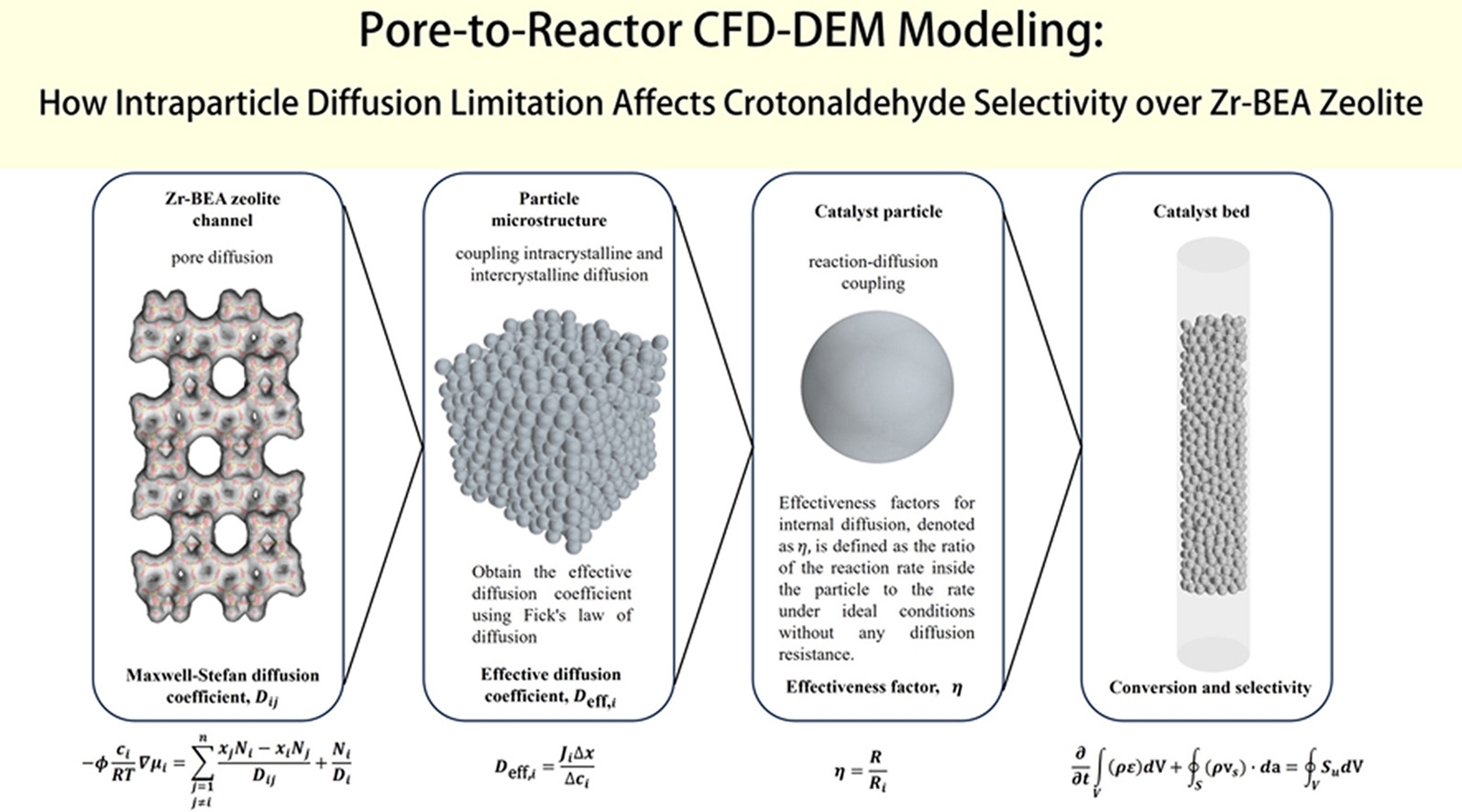
Heterogeneous aldol condensation of acetaldehyde to crotonaldehyde catalyzed by Zr-BEA zeolite holds significant industrial potential. However, the molecular diffusion is limited by the complex structure and various size of zeolite particles, leading to crotonaldehyde accumulation and over-condensation, which reduces process efficiency. Therefore, a thorough understanding of the intraparticle reaction-diffusion process is necessary for further industrial application. A micron-scale model of the zeolite particle was established using Discrete Element Method (DEM), and Computational Fluid Dynamics (CFD) simulations were conducted to obtain the effective diffusion coefficient of each component across a range of temperature. Integrating these coefficients with intrinsic kinetic equations, an intraparticle reaction-diffusion model was established to investigate the effect of particle shape and size on the process. A quantitative correlation was established among temperature, acetaldehyde partial pressure, and the internal diffusion effectiveness factor, yielding apparent kinetic equations that account for internal diffusion limitations. Based on the porous medium model, a fixed-bed reactor model was established to predict the distribution of velocity, temperature, and concentration under different process conditions. The results indicated that temperature had a more significant effect on product selectivity than the inlet flow rate or acetaldehyde partial pressure. As the temperature increased from 433.15 K to 493.15 K, the selectivity of crotonaldehyde first increased from 93.750% to 97.120% and then decreased to 82.180%, while the selectivity of over-condensation by-products increased from 0.370% to 17.730%.
Graphical abstract
Keywords
Aldol condensation; Crotonaldehyde; Zr-BEA zeolite; CFD; Reaction-diffusion
文章导读