
期刊文章
过刊浏览
- Volumes 108-119 (2025)
-
Volumes 96-107 (2025)
-
Volume 107
Pages 1-376 (December 2025)
-
Volume 106
Pages 1-336 (November 2025)
-
Volume 105
Pages 1-356 (October 2025)
-
Volume 104
Pages 1-332 (September 2025)
-
Volume 103
Pages 1-314 (August 2025)
-
Volume 102
Pages 1-276 (July 2025)
-
Volume 101
Pages 1-166 (June 2025)
-
Volume 100
Pages 1-256 (May 2025)
-
Volume 99
Pages 1-242 (April 2025)
-
Volume 98
Pages 1-288 (March 2025)
-
Volume 97
Pages 1-256 (February 2025)
-
Volume 96
Pages 1-340 (January 2025)
-
Volume 107
-
Volumes 84-95 (2024)
-
Volume 95
Pages 1-392 (December 2024)
-
Volume 94
Pages 1-400 (November 2024)
-
Volume 93
Pages 1-376 (October 2024)
-
Volume 92
Pages 1-316 (September 2024)
-
Volume 91
Pages 1-378 (August 2024)
-
Volume 90
Pages 1-580 (July 2024)
-
Volume 89
Pages 1-278 (June 2024)
-
Volume 88
Pages 1-350 (May 2024)
-
Volume 87
Pages 1-338 (April 2024)
-
Volume 86
Pages 1-312 (March 2024)
-
Volume 85
Pages 1-334 (February 2024)
-
Volume 84
Pages 1-308 (January 2024)
-
Volume 95
-
Volumes 72-83 (2023)
-
Volume 83
Pages 1-258 (December 2023)
-
Volume 82
Pages 1-204 (November 2023)
-
Volume 81
Pages 1-188 (October 2023)
-
Volume 80
Pages 1-202 (September 2023)
-
Volume 79
Pages 1-172 (August 2023)
-
Volume 78
Pages 1-146 (July 2023)
-
Volume 77
Pages 1-152 (June 2023)
-
Volume 76
Pages 1-176 (May 2023)
-
Volume 75
Pages 1-228 (April 2023)
-
Volume 74
Pages 1-200 (March 2023)
-
Volume 73
Pages 1-138 (February 2023)
-
Volume 72
Pages 1-144 (January 2023)
-
Volume 83
-
Volumes 60-71 (2022)
-
Volume 71
Pages 1-108 (December 2022)
-
Volume 70
Pages 1-106 (November 2022)
-
Volume 69
Pages 1-122 (October 2022)
-
Volume 68
Pages 1-124 (September 2022)
-
Volume 67
Pages 1-102 (August 2022)
-
Volume 66
Pages 1-112 (July 2022)
-
Volume 65
Pages 1-138 (June 2022)
-
Volume 64
Pages 1-186 (May 2022)
-
Volume 63
Pages 1-124 (April 2022)
-
Volume 62
Pages 1-104 (March 2022)
-
Volume 61
Pages 1-120 (February 2022)
-
Volume 60
Pages 1-124 (January 2022)
-
Volume 71
- Volumes 54-59 (2021)
- Volumes 48-53 (2020)
- Volumes 42-47 (2019)
- Volumes 36-41 (2018)
- Volumes 30-35 (2017)
- Volumes 24-29 (2016)
- Volumes 18-23 (2015)
- Volumes 12-17 (2014)
- Volume 11 (2013)
- Volume 10 (2012)
- Volume 9 (2011)
- Volume 8 (2010)
- Volume 7 (2009)
- Volume 6 (2008)
- Volume 5 (2007)
- Volume 4 (2006)
- Volume 3 (2005)
- Volume 2 (2004)
- Volume 1 (2003)
Volume 117
Effect of heterogeneous media in size and material on milling rate, efficiency, and particle size distribution in stirred media milling (Open Access)
Chiharu Tokoro a b *, Yuki Murata c, Shozo Tanaka c, Yutaro Takaya b a, Hidehiro Kamiya a, Kyoko Okuyama d, Yuma Hatakeyama d, Satoshi Shiina d, Osamu Ishikawa d
a Faculty of Science and Engineering, Waseda University, Tokyo, 169-8555, Japan
b Faculty of Engineering, The University of Tokyo, Tokyo, 113-8656, Japan
c Graduate School of Creative Science and Engineering, Waseda University, Tokyo, 169-8555, Japan
d Nippon Coke & Engineering Co., Ltd., Tochigi, 328-8503, Japan
10.1016/j.partic.2026.07.008
Volume 117,
October 2026,
Pages 249-261
Received 22 March 2026, Revised 5 July 2026, Accepted 16 July 2026, Available online 22 July 2026, Version of Record 6 August 2026.
E-mail:
tokoro@waseda.jp
Highlights
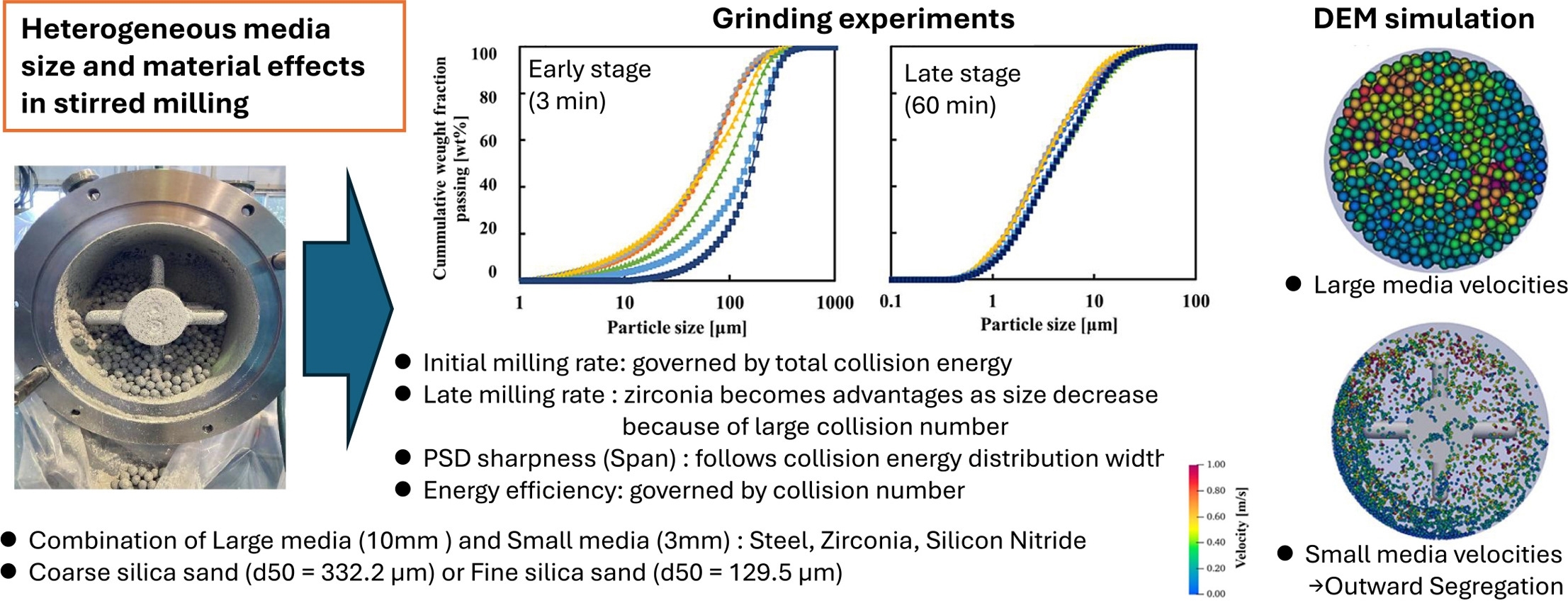
• Heterogeneous media significantly impact early grinding and size distribution.
• Large steel media accelerate initial grinding via high collision energy.
• Silicon nitride media enhance grinding efficiency through high collision frequency.
• Product size distribution span correlates with the DEM-derived collision energy span.
• Lighter small media segregate outward, altering collision statistics in mixed systems.
Abstract
This study investigated the effect of heterogeneous grinding media in size and material on the milling rate, grinding efficiency, and particle size distribution in a horizontal stirred media mill. Dry grinding experiments were conducted for two silica sand feeds with different initial sizes using mixed media composed of large and small beads of steel, zirconia, and silicon nitride. Discrete element method simulations were conducted without powder particles to compare the media collision statistics across the conditions. The experiments showed that the media combination most strongly affected the early grinding response, and the effect was more pronounced for the coarse feed. Steel as a large medium accelerated the initial size reduction, whereas media involving silicon nitride improved the grinding efficiency. Steel-containing combinations tended to yield broader particle size distributions, whereas zirconia and silicon nitride combinations produced sharper distributions. The simulations demonstrated that the grinding trends cannot be explained solely by the collision energy magnitude and that the collision frequency and spread of collision energies are also important. The energy span derived from the collision energy distributions followed the same order as the span of the product particle size distribution. The simulations also indicated the outward segregation of lighter small media, providing a physical basis for changes in the collision statistics in mixed material systems.
Graphical abstract
Keywords
Discrete element method; Attrition; Collision energy; Media density; Grinding kinetics
文章导读