
期刊文章
过刊浏览
- Volumes 108-119 (2025)
-
Volumes 96-107 (2025)
-
Volume 107
Pages 1-376 (December 2025)
-
Volume 106
Pages 1-336 (November 2025)
-
Volume 105
Pages 1-356 (October 2025)
-
Volume 104
Pages 1-332 (September 2025)
-
Volume 103
Pages 1-314 (August 2025)
-
Volume 102
Pages 1-276 (July 2025)
-
Volume 101
Pages 1-166 (June 2025)
-
Volume 100
Pages 1-256 (May 2025)
-
Volume 99
Pages 1-242 (April 2025)
-
Volume 98
Pages 1-288 (March 2025)
-
Volume 97
Pages 1-256 (February 2025)
-
Volume 96
Pages 1-340 (January 2025)
-
Volume 107
-
Volumes 84-95 (2024)
-
Volume 95
Pages 1-392 (December 2024)
-
Volume 94
Pages 1-400 (November 2024)
-
Volume 93
Pages 1-376 (October 2024)
-
Volume 92
Pages 1-316 (September 2024)
-
Volume 91
Pages 1-378 (August 2024)
-
Volume 90
Pages 1-580 (July 2024)
-
Volume 89
Pages 1-278 (June 2024)
-
Volume 88
Pages 1-350 (May 2024)
-
Volume 87
Pages 1-338 (April 2024)
-
Volume 86
Pages 1-312 (March 2024)
-
Volume 85
Pages 1-334 (February 2024)
-
Volume 84
Pages 1-308 (January 2024)
-
Volume 95
-
Volumes 72-83 (2023)
-
Volume 83
Pages 1-258 (December 2023)
-
Volume 82
Pages 1-204 (November 2023)
-
Volume 81
Pages 1-188 (October 2023)
-
Volume 80
Pages 1-202 (September 2023)
-
Volume 79
Pages 1-172 (August 2023)
-
Volume 78
Pages 1-146 (July 2023)
-
Volume 77
Pages 1-152 (June 2023)
-
Volume 76
Pages 1-176 (May 2023)
-
Volume 75
Pages 1-228 (April 2023)
-
Volume 74
Pages 1-200 (March 2023)
-
Volume 73
Pages 1-138 (February 2023)
-
Volume 72
Pages 1-144 (January 2023)
-
Volume 83
-
Volumes 60-71 (2022)
-
Volume 71
Pages 1-108 (December 2022)
-
Volume 70
Pages 1-106 (November 2022)
-
Volume 69
Pages 1-122 (October 2022)
-
Volume 68
Pages 1-124 (September 2022)
-
Volume 67
Pages 1-102 (August 2022)
-
Volume 66
Pages 1-112 (July 2022)
-
Volume 65
Pages 1-138 (June 2022)
-
Volume 64
Pages 1-186 (May 2022)
-
Volume 63
Pages 1-124 (April 2022)
-
Volume 62
Pages 1-104 (March 2022)
-
Volume 61
Pages 1-120 (February 2022)
-
Volume 60
Pages 1-124 (January 2022)
-
Volume 71
- Volumes 54-59 (2021)
- Volumes 48-53 (2020)
- Volumes 42-47 (2019)
- Volumes 36-41 (2018)
- Volumes 30-35 (2017)
- Volumes 24-29 (2016)
- Volumes 18-23 (2015)
- Volumes 12-17 (2014)
- Volume 11 (2013)
- Volume 10 (2012)
- Volume 9 (2011)
- Volume 8 (2010)
- Volume 7 (2009)
- Volume 6 (2008)
- Volume 5 (2007)
- Volume 4 (2006)
- Volume 3 (2005)
- Volume 2 (2004)
- Volume 1 (2003)
Volume 117
A study on the effects of different crushing methods on the surface properties of high-nickel electrode materials and related behavior in lithium recovery
Wenzhe Wang a, Bu Chu a, Xueying He a, Shengmao Lin a, Weining Xie a b *, Linhan Ge c, Fengbin Zhang d, Qisen Xue e, Tao Zhang e *
a School of Chemical Engineering, China University of Mining and Technology, Xuzhou, 221116, China
b Advanced Analysis & Computation, Center, China University of Mining and Technology, Xuzhou, 221116, China
c Institute of Nuclear and New Energy Technology, Tsinghua University, Beijing, 100084, China
d Key Laboratory of Xinjiang Coal Resources Green Mining, Ministry of Education, Xinjiang Institute of Engineering, Urumqi, 830023, China
e Beichen Advanced Recycling Technology (Qingdao) Co., Ltd, Qingdao, 266041, China
10.1016/j.partic.2026.07.014
Volume 117,
October 2026,
Pages 262-274
E-mail:
Received 14 May 2026, Revised 9 July 2026, Accepted 24 July 2026, Available online 25 July 2026, Version of Record 6 August 2026.
Highlights
• Charged-state crushing and post-discharge crushing exert different effects on the material structure and binder content.
• Organic components exhibit similar thermal mass-loss behavior after charged-state crushing and post-discharge crushing.
• Two pretreatment routes promote different lithium dissociation mechanisms in materials.
• Aluminum impurities in the black mass obtained through two pretreatment routes significantly affect material leaching.
Abstract
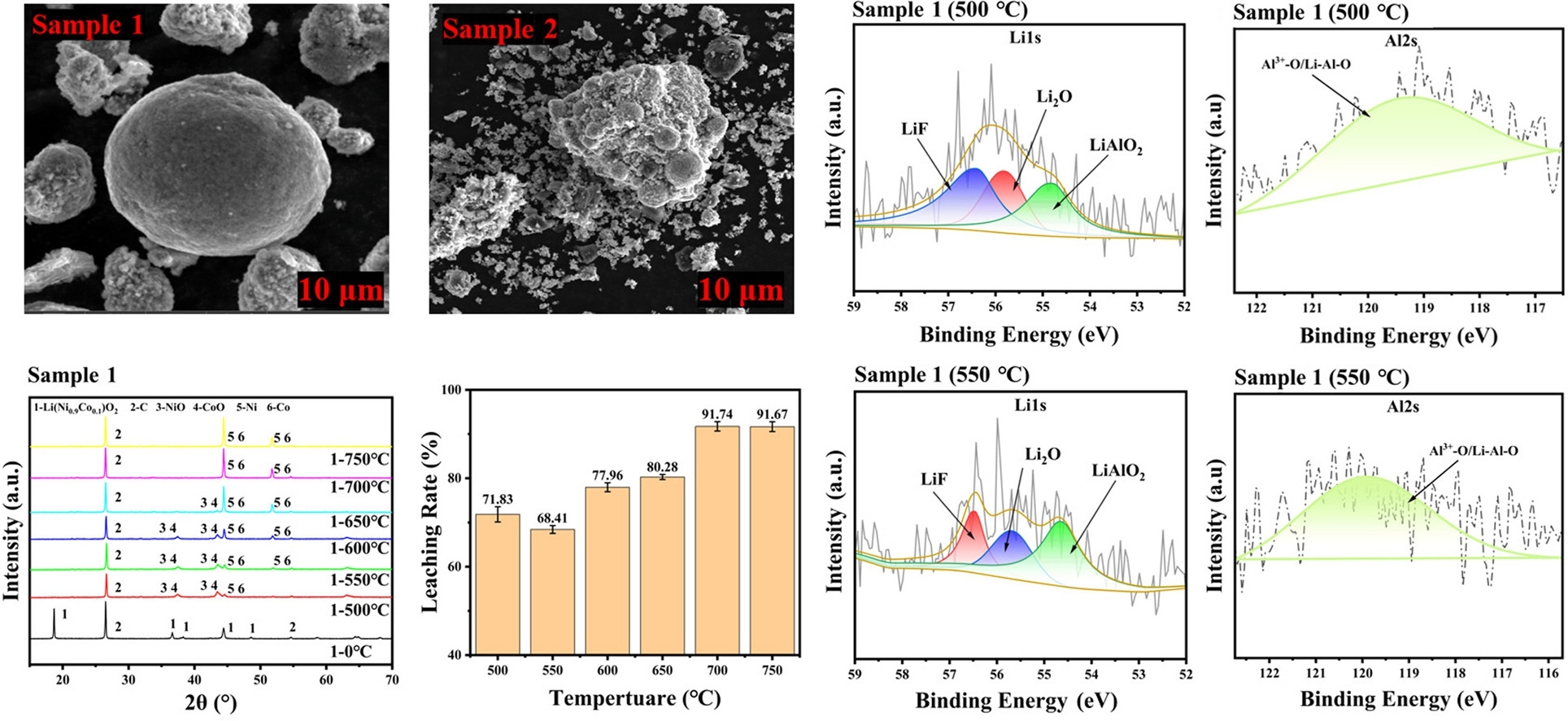
This study compared the effects of charged-state crushing and post-discharge crushing on the surface chemistry, thermal-reduction behavior, and water-leaching characteristics of spent nickel-rich electrode materials. Charged-state crushing disrupted the layered structure, reduced the surface coverage of binder residues, decreased the content of PVDF-related functional groups from 39% to 26%, and lowered the surface Ni3+ fraction from 70% to 56%. After thermal reduction at 500 °C for 1 h, the original layered phases of both samples were substantially destroyed, and lithium leaching efficiencies reached 71% and 75%, respectively. At lower temperatures, the post-discharge-crushed sample exhibited higher lithium extraction efficiency; the maximum difference, 12.57%, occurred at 550 °C, mainly due to Li+ redistribution into the cathode lattice during discharge. By contrast, lithium release from the charged-state-crushed sample relied more strongly on graphite-assisted carbothermic reduction and was limited by residual lithium in graphite/interfacial deposits and the formation of water-insoluble LiAlO2. At 700 °C, most NiO and CoO were reduced to metallic Ni and Co, and lithium leaching efficiency exceeded 90%. These results demonstrate that pretreatment routes affect efficient lithium recovery from spent nickel-rich lithium-ion batteries by regulating PVDF decomposition, Ni valence-state evolution, LiAlO2 formation, and lithium-release pathways.
Graphical abstract
Keywords
Spent nickel-rich electrode materials; Charged-state crushing; Post-discharge crushing; Lithium leaching; LiAlO2
文章导读