
期刊文章
过刊浏览
- Volumes 108-119 (2025)
-
Volumes 96-107 (2025)
-
Volume 107
Pages 1-376 (December 2025)
-
Volume 106
Pages 1-336 (November 2025)
-
Volume 105
Pages 1-356 (October 2025)
-
Volume 104
Pages 1-332 (September 2025)
-
Volume 103
Pages 1-314 (August 2025)
-
Volume 102
Pages 1-276 (July 2025)
-
Volume 101
Pages 1-166 (June 2025)
-
Volume 100
Pages 1-256 (May 2025)
-
Volume 99
Pages 1-242 (April 2025)
-
Volume 98
Pages 1-288 (March 2025)
-
Volume 97
Pages 1-256 (February 2025)
-
Volume 96
Pages 1-340 (January 2025)
-
Volume 107
-
Volumes 84-95 (2024)
-
Volume 95
Pages 1-392 (December 2024)
-
Volume 94
Pages 1-400 (November 2024)
-
Volume 93
Pages 1-376 (October 2024)
-
Volume 92
Pages 1-316 (September 2024)
-
Volume 91
Pages 1-378 (August 2024)
-
Volume 90
Pages 1-580 (July 2024)
-
Volume 89
Pages 1-278 (June 2024)
-
Volume 88
Pages 1-350 (May 2024)
-
Volume 87
Pages 1-338 (April 2024)
-
Volume 86
Pages 1-312 (March 2024)
-
Volume 85
Pages 1-334 (February 2024)
-
Volume 84
Pages 1-308 (January 2024)
-
Volume 95
-
Volumes 72-83 (2023)
-
Volume 83
Pages 1-258 (December 2023)
-
Volume 82
Pages 1-204 (November 2023)
-
Volume 81
Pages 1-188 (October 2023)
-
Volume 80
Pages 1-202 (September 2023)
-
Volume 79
Pages 1-172 (August 2023)
-
Volume 78
Pages 1-146 (July 2023)
-
Volume 77
Pages 1-152 (June 2023)
-
Volume 76
Pages 1-176 (May 2023)
-
Volume 75
Pages 1-228 (April 2023)
-
Volume 74
Pages 1-200 (March 2023)
-
Volume 73
Pages 1-138 (February 2023)
-
Volume 72
Pages 1-144 (January 2023)
-
Volume 83
-
Volumes 60-71 (2022)
-
Volume 71
Pages 1-108 (December 2022)
-
Volume 70
Pages 1-106 (November 2022)
-
Volume 69
Pages 1-122 (October 2022)
-
Volume 68
Pages 1-124 (September 2022)
-
Volume 67
Pages 1-102 (August 2022)
-
Volume 66
Pages 1-112 (July 2022)
-
Volume 65
Pages 1-138 (June 2022)
-
Volume 64
Pages 1-186 (May 2022)
-
Volume 63
Pages 1-124 (April 2022)
-
Volume 62
Pages 1-104 (March 2022)
-
Volume 61
Pages 1-120 (February 2022)
-
Volume 60
Pages 1-124 (January 2022)
-
Volume 71
- Volumes 54-59 (2021)
- Volumes 48-53 (2020)
- Volumes 42-47 (2019)
- Volumes 36-41 (2018)
- Volumes 30-35 (2017)
- Volumes 24-29 (2016)
- Volumes 18-23 (2015)
- Volumes 12-17 (2014)
- Volume 11 (2013)
- Volume 10 (2012)
- Volume 9 (2011)
- Volume 8 (2010)
- Volume 7 (2009)
- Volume 6 (2008)
- Volume 5 (2007)
- Volume 4 (2006)
- Volume 3 (2005)
- Volume 2 (2004)
- Volume 1 (2003)
Volume 117
Laboratory-scale demonstration of the high-potential applicability of porous α-Al2O3-supported Ni catalyst in fluidized-bed methane reforming
Yizheng Li a b c, Na Xu a, Yixin Huang a, Hongxu Zhang d, Ke Li d *, Zhanguo Zhang a b *, Guangwen Xu a *
a Key Laboratory on Resources Chemicals and Material of Ministry of Education, Shenyang University of Chemical Technology, Shenyang, 110142, China
b School of Materials Science and Engineering, Shenyang University of Technology, Shenyang, 110870, China
c School of Environmental and Chemical Engineering, Shenyang University of Technology, Shenyang, 110870, China
d Binzhou Huanghai Science and Technology Research Institute Co., Ltd., Binzhou, 256601, China
10.1016/j.partic.2026.07.013
Volume 117,
October 2026,
Pages 275-286
Received 7 May 2026, Revised 3 July 2026, Accepted 18 July 2026, Available online 25 July 2026, Version of Record 6 August 2026.
E-mail:
like@qiaochang.com; zhangaist@syuct.edu.cn; gwxu@syuct.edu.cn
Highlights
• A robust porous α-Al2O3 supported Ni catalyst was developed for CH4 reforming.
• Lab-scale catalytic fluidized-bed reforming tests were done at severe conditions.
• Stable and near-equilibrium CH4 conversion was obtained over a 137 h test period.
• The catalyst gave a coking rate of 0.009 wt%/h and an attrition rate of 0.063 wt%.
• The catalyst proved high potential applicability in the fluidized bed reforming.
Abstract
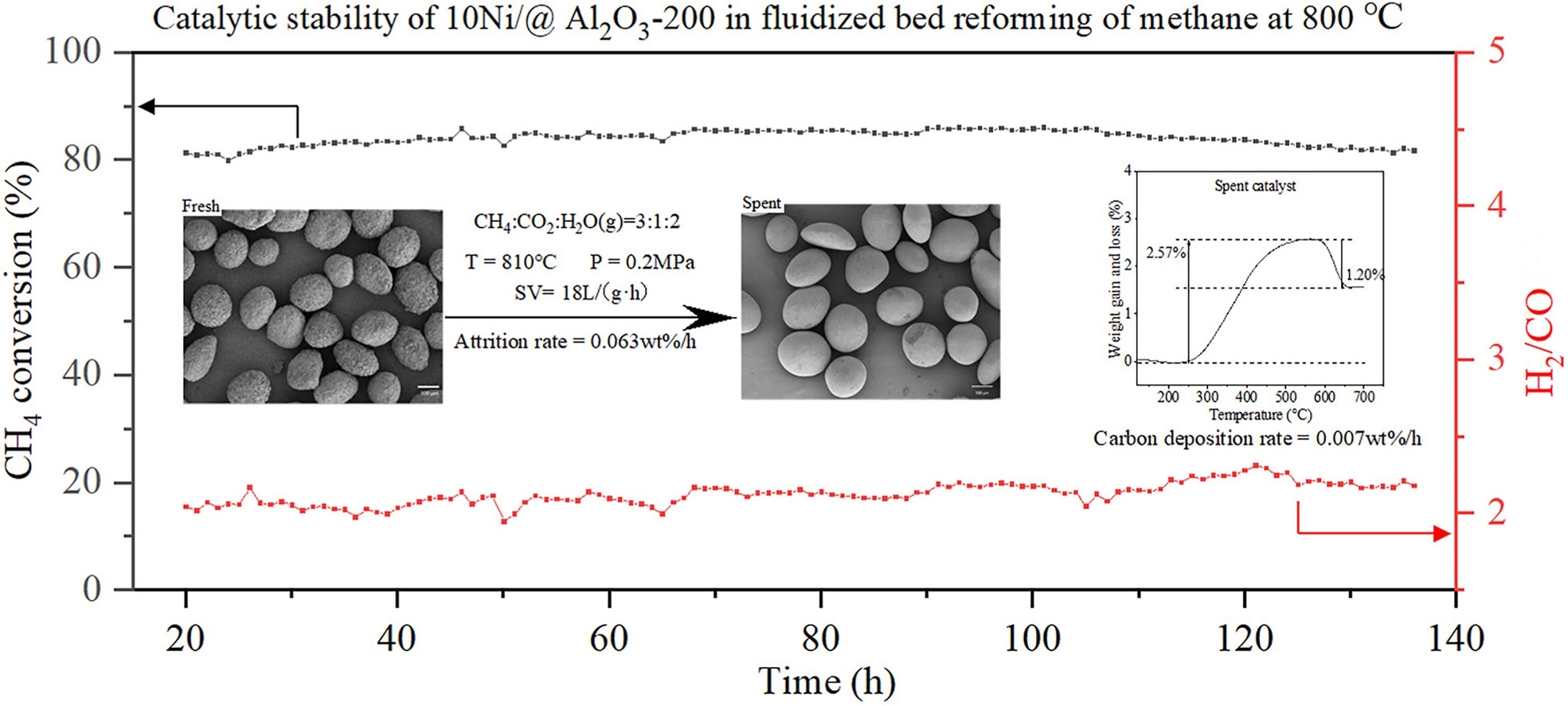
Industrial application of the fluidized bed methane reforming technology for syngas production requires a robust catalyst with simultaneously high activity, high anti-coking ability and high attrition resistance. A highly fluidizable porous α-Al2O3 supported Ni catalyst was tested in a 50 mm I.D. fluidized-bed reactor system for the methane reforming. After the minimum catalyst charge needed for attaining the near-equilibrium CH4 conversion was determined through a set of 340 min dry reforming tests, a 137 h continuous CO2/water-steam combined bi-reforming test was conducted in a stream composed of a mass flow of 3 L/min CH4, 1 L/min CO2 and 2 L/min H2O(g) at 0.2 MPa, 810 °C and a space velocity of 18 L/(g h) to confirm the catalyst's activity stability. Near-equilibrium CH4 conversions and slightly higher than equilibrium H2/CO ratios were obtained over most of the test period. Quantification of the spent bed particles and the fines entrained into a downstream filter was conducted to estimate the average attrition rate of the catalyst and a low rate of 0.063 wt%/h was obtained. TG measurement of the spent catalyst was performed to evaluate the average carbon deposition rate, and a small rate of 0.009 wt%/h was obtained. All these together demonstrate that the tested catalyst has high-potential applicability in the fluidized bed methane reforming process.
Graphical abstract
Keywords
Fluidized-bed reactor; Methane bi-reforming; Ni-based catalyst; Porous α-Al2O3 support
文章导读