
期刊文章
过刊浏览
- Volumes 108-119 (2025)
-
Volumes 96-107 (2025)
-
Volume 107
Pages 1-376 (December 2025)
-
Volume 106
Pages 1-336 (November 2025)
-
Volume 105
Pages 1-356 (October 2025)
-
Volume 104
Pages 1-332 (September 2025)
-
Volume 103
Pages 1-314 (August 2025)
-
Volume 102
Pages 1-276 (July 2025)
-
Volume 101
Pages 1-166 (June 2025)
-
Volume 100
Pages 1-256 (May 2025)
-
Volume 99
Pages 1-242 (April 2025)
-
Volume 98
Pages 1-288 (March 2025)
-
Volume 97
Pages 1-256 (February 2025)
-
Volume 96
Pages 1-340 (January 2025)
-
Volume 107
-
Volumes 84-95 (2024)
-
Volume 95
Pages 1-392 (December 2024)
-
Volume 94
Pages 1-400 (November 2024)
-
Volume 93
Pages 1-376 (October 2024)
-
Volume 92
Pages 1-316 (September 2024)
-
Volume 91
Pages 1-378 (August 2024)
-
Volume 90
Pages 1-580 (July 2024)
-
Volume 89
Pages 1-278 (June 2024)
-
Volume 88
Pages 1-350 (May 2024)
-
Volume 87
Pages 1-338 (April 2024)
-
Volume 86
Pages 1-312 (March 2024)
-
Volume 85
Pages 1-334 (February 2024)
-
Volume 84
Pages 1-308 (January 2024)
-
Volume 95
-
Volumes 72-83 (2023)
-
Volume 83
Pages 1-258 (December 2023)
-
Volume 82
Pages 1-204 (November 2023)
-
Volume 81
Pages 1-188 (October 2023)
-
Volume 80
Pages 1-202 (September 2023)
-
Volume 79
Pages 1-172 (August 2023)
-
Volume 78
Pages 1-146 (July 2023)
-
Volume 77
Pages 1-152 (June 2023)
-
Volume 76
Pages 1-176 (May 2023)
-
Volume 75
Pages 1-228 (April 2023)
-
Volume 74
Pages 1-200 (March 2023)
-
Volume 73
Pages 1-138 (February 2023)
-
Volume 72
Pages 1-144 (January 2023)
-
Volume 83
-
Volumes 60-71 (2022)
-
Volume 71
Pages 1-108 (December 2022)
-
Volume 70
Pages 1-106 (November 2022)
-
Volume 69
Pages 1-122 (October 2022)
-
Volume 68
Pages 1-124 (September 2022)
-
Volume 67
Pages 1-102 (August 2022)
-
Volume 66
Pages 1-112 (July 2022)
-
Volume 65
Pages 1-138 (June 2022)
-
Volume 64
Pages 1-186 (May 2022)
-
Volume 63
Pages 1-124 (April 2022)
-
Volume 62
Pages 1-104 (March 2022)
-
Volume 61
Pages 1-120 (February 2022)
-
Volume 60
Pages 1-124 (January 2022)
-
Volume 71
- Volumes 54-59 (2021)
- Volumes 48-53 (2020)
- Volumes 42-47 (2019)
- Volumes 36-41 (2018)
- Volumes 30-35 (2017)
- Volumes 24-29 (2016)
- Volumes 18-23 (2015)
- Volumes 12-17 (2014)
- Volume 11 (2013)
- Volume 10 (2012)
- Volume 9 (2011)
- Volume 8 (2010)
- Volume 7 (2009)
- Volume 6 (2008)
- Volume 5 (2007)
- Volume 4 (2006)
- Volume 3 (2005)
- Volume 2 (2004)
- Volume 1 (2003)
Volume 117
Multiscale dense-phase structures in a 700-MW-class cold-state CFB boiler model using sequence-aware optical feature fusion
Wanchang Chen a, Wuliang Yin b, Jianxin Pan c, Min Wang d, Hua Wang a, Kai Yang a *, Qingtai Xiao a *
a State Key Laboratory of Complex Nonferrous Metal Resources Clean Utilization, School of Metallurgical and Energy Engineering, Kunming University of Science and Technology, Kunming, 650093, China
b Department of Electrical and Electronic Engineering, School of Engineering, Faculty of Science and Engineering, The University of Manchester, Manchester, M13 9PL, UK
c Guangdong Provincial Key Laboratory of Interdisciplinary Research and Application for Data Science, Faculty of Science and Technology, Beijing Normal-Hong Kong Baptist University, Zhuhai, Guangdong, 519087, China
d Department of Statistics and Data Science, College of AI, Cyber and Computing, The University of Texas at San Antonio, San Antonio, TX, 78249-0634, USA
10.1016/j.partic.2026.07.011
Volume 117,
October 2026,
Pages 287-302
Received 21 February 2026, Revised 8 July 2026, Accepted 16 July 2026, Available online 29 July 2026, Version of Record 7 August 2026.
E-mail:
kaiyang@kust.edu.cn; qingtai.xiao@kust.edu.cn
Highlights
• Fluidized bed image features are mapped to multi-scale calibrated metrics.
• Proposing a leak-free two-stage stack with PSO-tuned short-sequence modelling.
• Reveals slope compression in length scales from wall channels and core flattening.
• Explains high accuracy of bulk solids and interface via monotonic image links.
• Establishes lighting and position diagnostics, improving robustness across flow groups.
Abstract
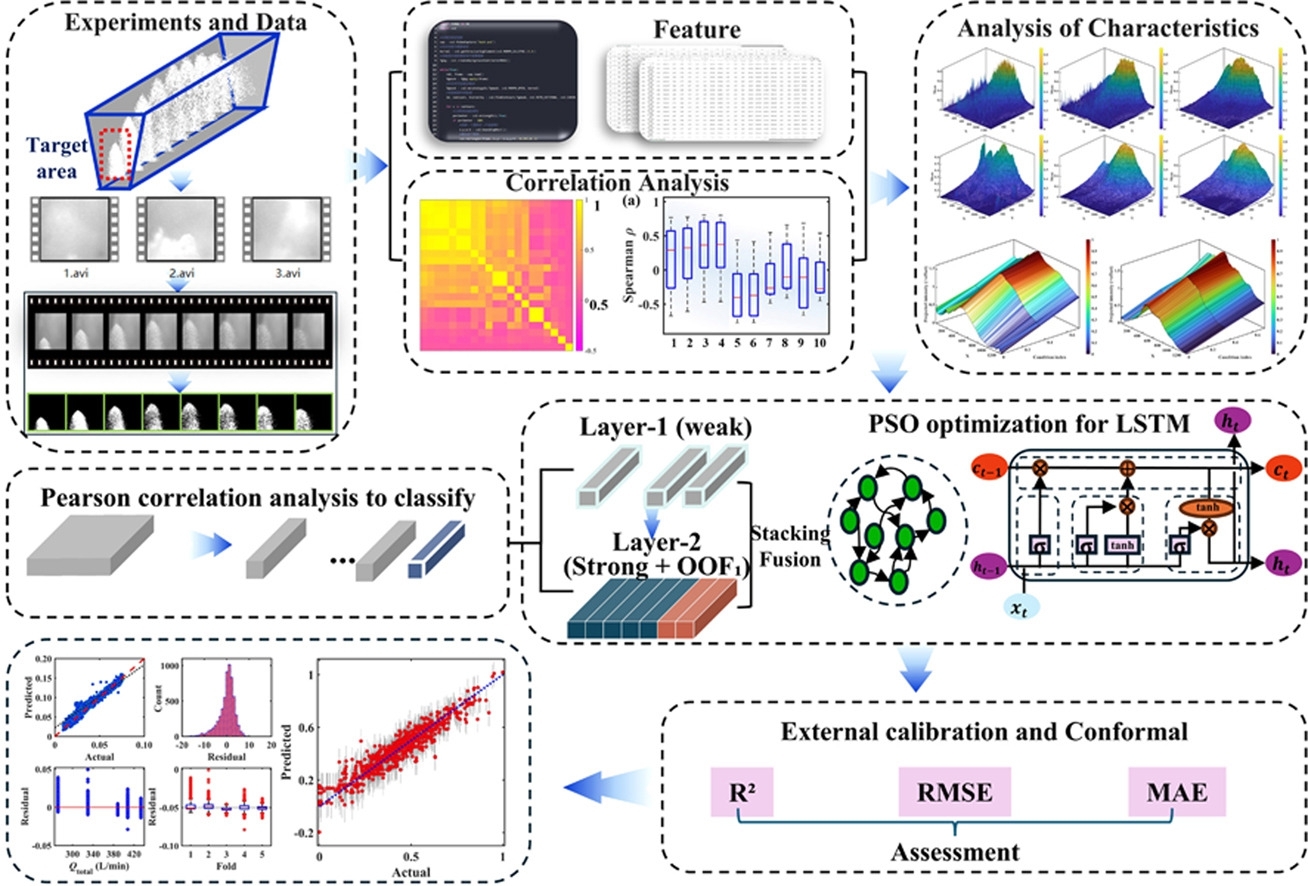
Dense-phase hydrodynamics in large circulating fluidized bed (CFB) boilers strongly influences performance, yet its spatiotemporal variability is complicated to quantify with conventional diagnostics. An optical data driven workflow is developed on a 700 MW class cold state CFB boiler model to map time resolved recordings to calibrated hydrodynamic quantities that remain valid across gas flow settings and lateral positions. The proposed method combines background modeling, morphological refinement, image descriptor extraction, correlation aware two-level stacking, and short window long short-term memory modeling to estimate dense phase hydrodynamic quantities. Isotonic calibration, conformal prediction, and multitask ridge regression are further used to obtain calibrated estimates and 90% prediction intervals. Under leave-one-group-out validation by gas flow setting, the workflow achieves a macro-averaged R-squared of 0.69 and reduces normalized error by 10-15% relative to the strongest single-model baseline. Overall solids fraction and normalized interface height reach R-squared values of 0.86 and 0.85 with near nominal coverage. Predictions for anisotropic correlation-length surrogates are moderate, and monotone calibration mitigates upper range compression. The results show that the proposed workflow provides physically consistent, uncertainty quantified quantities that are suited to trend monitoring, regime discrimination, and measurement planning in large CFB systems.
Graphical abstract
Keywords
Circulating fluidized bed; Dense-phase hydrodynamics; Stacking ensemble algorithm; Data-driven modeling; Uncertainty quantification
文章导读