
期刊文章
过刊浏览
- Volumes 108-119 (2025)
-
Volumes 96-107 (2025)
-
Volume 107
Pages 1-376 (December 2025)
-
Volume 106
Pages 1-336 (November 2025)
-
Volume 105
Pages 1-356 (October 2025)
-
Volume 104
Pages 1-332 (September 2025)
-
Volume 103
Pages 1-314 (August 2025)
-
Volume 102
Pages 1-276 (July 2025)
-
Volume 101
Pages 1-166 (June 2025)
-
Volume 100
Pages 1-256 (May 2025)
-
Volume 99
Pages 1-242 (April 2025)
-
Volume 98
Pages 1-288 (March 2025)
-
Volume 97
Pages 1-256 (February 2025)
-
Volume 96
Pages 1-340 (January 2025)
-
Volume 107
-
Volumes 84-95 (2024)
-
Volume 95
Pages 1-392 (December 2024)
-
Volume 94
Pages 1-400 (November 2024)
-
Volume 93
Pages 1-376 (October 2024)
-
Volume 92
Pages 1-316 (September 2024)
-
Volume 91
Pages 1-378 (August 2024)
-
Volume 90
Pages 1-580 (July 2024)
-
Volume 89
Pages 1-278 (June 2024)
-
Volume 88
Pages 1-350 (May 2024)
-
Volume 87
Pages 1-338 (April 2024)
-
Volume 86
Pages 1-312 (March 2024)
-
Volume 85
Pages 1-334 (February 2024)
-
Volume 84
Pages 1-308 (January 2024)
-
Volume 95
-
Volumes 72-83 (2023)
-
Volume 83
Pages 1-258 (December 2023)
-
Volume 82
Pages 1-204 (November 2023)
-
Volume 81
Pages 1-188 (October 2023)
-
Volume 80
Pages 1-202 (September 2023)
-
Volume 79
Pages 1-172 (August 2023)
-
Volume 78
Pages 1-146 (July 2023)
-
Volume 77
Pages 1-152 (June 2023)
-
Volume 76
Pages 1-176 (May 2023)
-
Volume 75
Pages 1-228 (April 2023)
-
Volume 74
Pages 1-200 (March 2023)
-
Volume 73
Pages 1-138 (February 2023)
-
Volume 72
Pages 1-144 (January 2023)
-
Volume 83
-
Volumes 60-71 (2022)
-
Volume 71
Pages 1-108 (December 2022)
-
Volume 70
Pages 1-106 (November 2022)
-
Volume 69
Pages 1-122 (October 2022)
-
Volume 68
Pages 1-124 (September 2022)
-
Volume 67
Pages 1-102 (August 2022)
-
Volume 66
Pages 1-112 (July 2022)
-
Volume 65
Pages 1-138 (June 2022)
-
Volume 64
Pages 1-186 (May 2022)
-
Volume 63
Pages 1-124 (April 2022)
-
Volume 62
Pages 1-104 (March 2022)
-
Volume 61
Pages 1-120 (February 2022)
-
Volume 60
Pages 1-124 (January 2022)
-
Volume 71
- Volumes 54-59 (2021)
- Volumes 48-53 (2020)
- Volumes 42-47 (2019)
- Volumes 36-41 (2018)
- Volumes 30-35 (2017)
- Volumes 24-29 (2016)
- Volumes 18-23 (2015)
- Volumes 12-17 (2014)
- Volume 11 (2013)
- Volume 10 (2012)
- Volume 9 (2011)
- Volume 8 (2010)
- Volume 7 (2009)
- Volume 6 (2008)
- Volume 5 (2007)
- Volume 4 (2006)
- Volume 3 (2005)
- Volume 2 (2004)
- Volume 1 (2003)
Volume 117
A DEM study on granular flow in twin-blade vertical kneader
Yingyi Chen a, Yang Yang a b, Meiqi Wu a c, Mukhtiar Ahmed a, Jinhui Zhan a, Xiaoxing Liu a b *
a State Key Laboratory of Mesoscience and Process Engineering, Institute of Process Engineering, Chinese Academy of Sciences, Beijing, 100190, China
b School of Chemical Engineering, University of Chinese Academy of Sciences, Beijing, 100049, China
c School of Chemical Engineering and Technology, Tianjin University, 300350, Tianjin, China
10.1016/j.partic.2026.07.009
Volume 117,
October 2026,
Pages 303-314
Received 13 May 2026, Revised 2 July 2026, Accepted 16 July 2026, Available online 23 July 2026, Version of Record 7 August 2026.
E-mail:
xxliu@ipe.ac.cn
Highlights
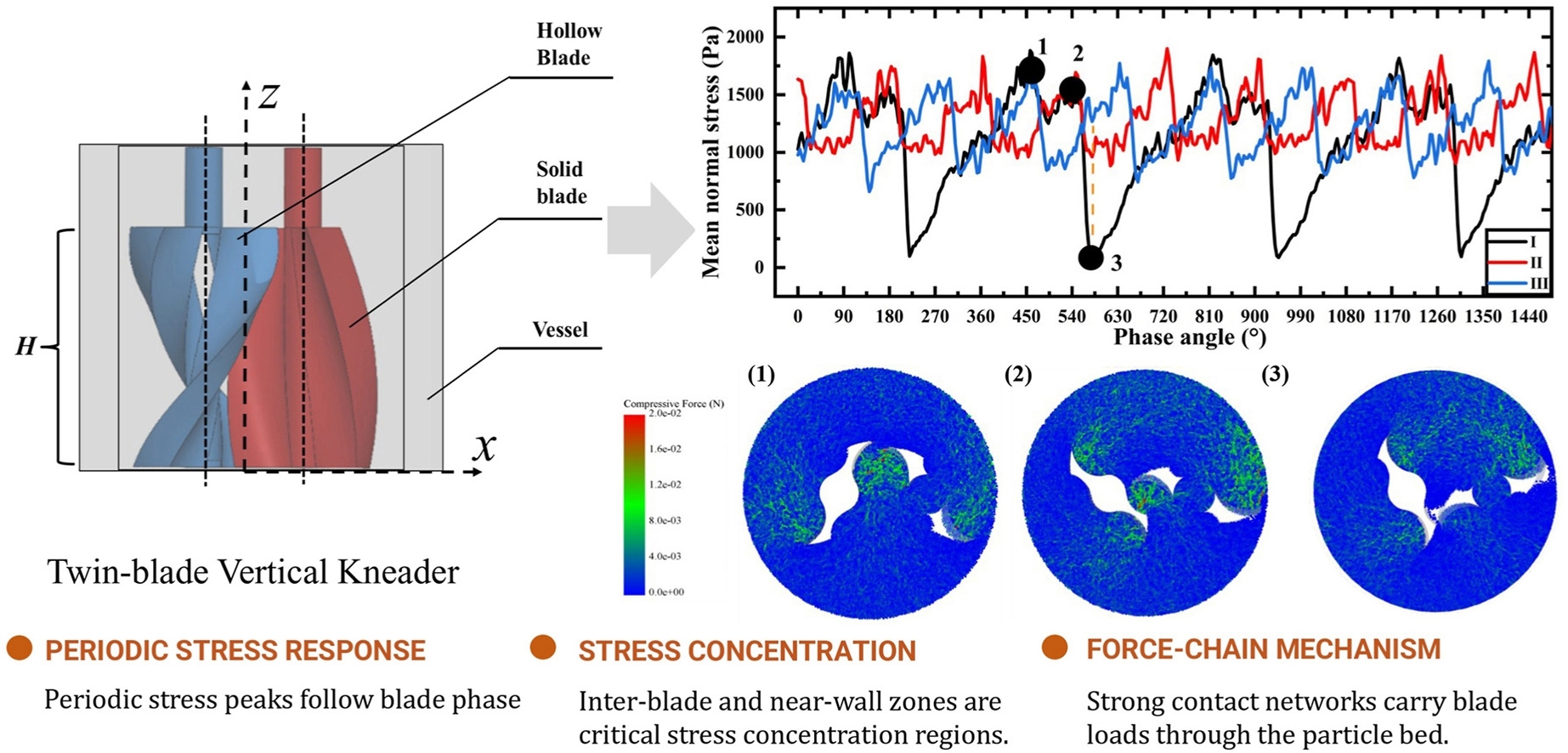
• The kneader produces two kneading events per cycle, with higher stress during the second one.
• Stress at all marked positions exhibits clear periodicity due to the periodic rotation of blades.
• Normalized blade stress increases with depth due to stronger lateral confinement below and higher background pressure.
• Force chains across two blades and to the wall induce force concentration in mixing.
Abstract
Particle mixing is essential for ensuring product quality across many industries, and for energetic materials where stress concentrations can lead to unexpected explosion, it is directly linked to operational safety. Understanding mixing dynamics and stress evolution at the particle scale is therefore crucial for the safe operation of mixing equipment. In this study, the granular flow and stress evolution within a twin-blade vertical kneader were investigated using Discrete Element Method (DEM) simulations. The effects of blade rotational velocity and clearances on stress distribution were systematically examined. The results show that distinct stress concentrations were observed in the region between the two blades and near the wall, particularly during the kneading stages, characterized by the formation of strong force-chain networks. These stress concentrations were primarily attributed to velocity discrepancies between the blades, with stresses increasing linearly with rotational velocity. Additionally, smaller clearances were found to generate extremely high instantaneous stresses, posing potential safety risks. Overall, this work provides new insights into the mixing mechanisms and stress concentration phenomena in vertical twin-blade kneaders, offering valuable guidance for the design, optimization, and safe operation of particle mixing processes.
Graphical abstract
Keywords
Discrete element method; Twin-blade kneader; Granular flow; Stress concentration; Force chain; Energetic materials
文章导读