
期刊文章
过刊浏览
- Volumes 108-119 (2025)
-
Volumes 96-107 (2025)
-
Volume 107
Pages 1-376 (December 2025)
-
Volume 106
Pages 1-336 (November 2025)
-
Volume 105
Pages 1-356 (October 2025)
-
Volume 104
Pages 1-332 (September 2025)
-
Volume 103
Pages 1-314 (August 2025)
-
Volume 102
Pages 1-276 (July 2025)
-
Volume 101
Pages 1-166 (June 2025)
-
Volume 100
Pages 1-256 (May 2025)
-
Volume 99
Pages 1-242 (April 2025)
-
Volume 98
Pages 1-288 (March 2025)
-
Volume 97
Pages 1-256 (February 2025)
-
Volume 96
Pages 1-340 (January 2025)
-
Volume 107
-
Volumes 84-95 (2024)
-
Volume 95
Pages 1-392 (December 2024)
-
Volume 94
Pages 1-400 (November 2024)
-
Volume 93
Pages 1-376 (October 2024)
-
Volume 92
Pages 1-316 (September 2024)
-
Volume 91
Pages 1-378 (August 2024)
-
Volume 90
Pages 1-580 (July 2024)
-
Volume 89
Pages 1-278 (June 2024)
-
Volume 88
Pages 1-350 (May 2024)
-
Volume 87
Pages 1-338 (April 2024)
-
Volume 86
Pages 1-312 (March 2024)
-
Volume 85
Pages 1-334 (February 2024)
-
Volume 84
Pages 1-308 (January 2024)
-
Volume 95
-
Volumes 72-83 (2023)
-
Volume 83
Pages 1-258 (December 2023)
-
Volume 82
Pages 1-204 (November 2023)
-
Volume 81
Pages 1-188 (October 2023)
-
Volume 80
Pages 1-202 (September 2023)
-
Volume 79
Pages 1-172 (August 2023)
-
Volume 78
Pages 1-146 (July 2023)
-
Volume 77
Pages 1-152 (June 2023)
-
Volume 76
Pages 1-176 (May 2023)
-
Volume 75
Pages 1-228 (April 2023)
-
Volume 74
Pages 1-200 (March 2023)
-
Volume 73
Pages 1-138 (February 2023)
-
Volume 72
Pages 1-144 (January 2023)
-
Volume 83
-
Volumes 60-71 (2022)
-
Volume 71
Pages 1-108 (December 2022)
-
Volume 70
Pages 1-106 (November 2022)
-
Volume 69
Pages 1-122 (October 2022)
-
Volume 68
Pages 1-124 (September 2022)
-
Volume 67
Pages 1-102 (August 2022)
-
Volume 66
Pages 1-112 (July 2022)
-
Volume 65
Pages 1-138 (June 2022)
-
Volume 64
Pages 1-186 (May 2022)
-
Volume 63
Pages 1-124 (April 2022)
-
Volume 62
Pages 1-104 (March 2022)
-
Volume 61
Pages 1-120 (February 2022)
-
Volume 60
Pages 1-124 (January 2022)
-
Volume 71
- Volumes 54-59 (2021)
- Volumes 48-53 (2020)
- Volumes 42-47 (2019)
- Volumes 36-41 (2018)
- Volumes 30-35 (2017)
- Volumes 24-29 (2016)
- Volumes 18-23 (2015)
- Volumes 12-17 (2014)
- Volume 11 (2013)
- Volume 10 (2012)
- Volume 9 (2011)
- Volume 8 (2010)
- Volume 7 (2009)
- Volume 6 (2008)
- Volume 5 (2007)
- Volume 4 (2006)
- Volume 3 (2005)
- Volume 2 (2004)
- Volume 1 (2003)
Volume 117
Systematic DEM parameter calibration and validation for co-processed pharmaceutical granules: A polyhedral particle and multi-response optimization approach
Marcos I. Díaz Muñoz a, Jacquelina C. Lobos de Ponga a b, Ivana M. Cotabarren a b 1 *, Juliana Piña a b 1
a Planta Piloto de Ingeniería Química (PLAPIQUI, UNS-CONICET), Bahía Blanca, Buenos Aires, Argentina
b Departamento de Ingeniería Química (DIQ), Universidad Nacional del Sur (UNS), Bahía Blanca, Buenos Aires, Argentina
10.1016/j.partic.2026.07.019
Volume 117,
October 2026,
Pages 315-328
Received 15 May 2026, Revised 1 July 2026, Accepted 24 July 2026, Available online 4 August 2026, Version of Record 12 August 2026.
E-mail:
icotabarren@plapiqui.edu.ar
Highlights
• A novel DEM calibration method using polyhedral particles is proposed.
• Multi-response optimization ensures accurate bulk flow properties prediction.
• Simulated AOR and bulk density matched experiments with <3.6% error.
• Drawdown test validation showed <10.8% angles error and 6.9% mass error.
• The approach offers a robust framework for DEM in pharmaceutical modeling.
Abstract
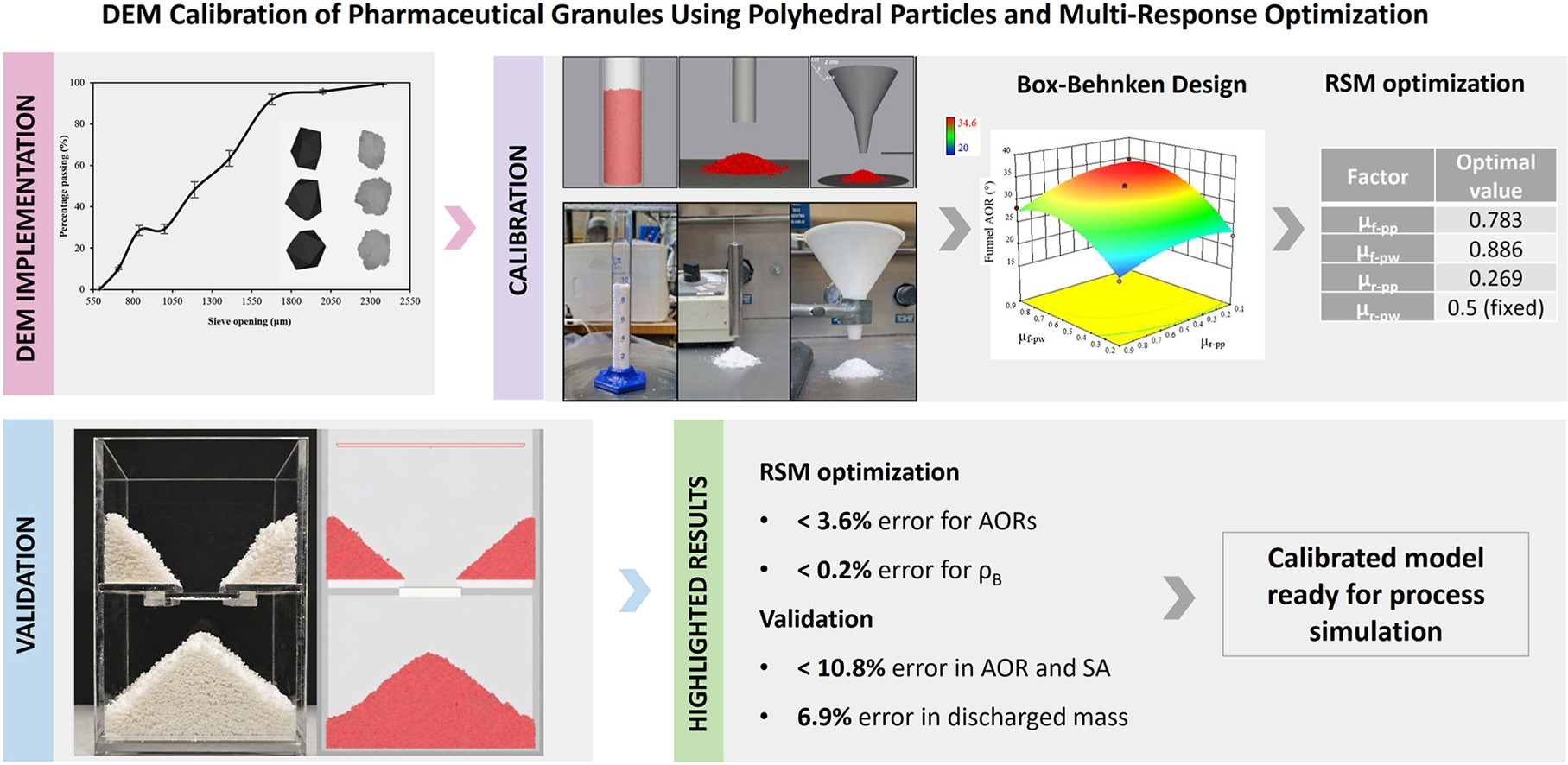
Accurate calibration of input parameters is essential for reliable Discrete Element Method (DEM) simulations of pharmaceutical granular materials. This study presents a systematic approach for the calibration and validation of DEM parameters using co-processed lactose-PEG 6000 granules, represented as polyhedral particles. A Box–Behnken experimental design was employed to evaluate the effects and interactions of key parameters—particle-particle and particle-wall friction, and restitution coefficients—on bulk density and angle of repose. Response surface methodology and multi-objective optimization using desirability functions were applied to identify the optimal parameter set that minimizes deviation from experimental measurements. DEM simulations using the optimized parameters reproduced the bulk behavior of the material with errors below 3.6% in angle of repose and bulk density. Model validation via the Drawdown Test confirmed a good predictive agreement, with errors under 10.8% for flow-related angles and 6.9% for discharged mass. The novelty of this work lies in the calibration of DEM parameters for small-sized pharmaceutical excipients using polyhedral particle representations, offering a more realistic alternative to conventional spherical models, particularly considering the strong influence of particle shape on the flow behavior and DEM calibration of fine powders reported in previous studies (Diviš et al., 2025). The proposed methodology provides a promising calibration framework for DEM parameter calibration in pharmaceutical applications, with the potential to support advanced modeling of powder-based processes such as mixing, milling, and tableting.
Graphical abstract
Keywords
Discrete element method; Pharmaceutical granules; Co-processed excipients; Response surface methodology; Parameter calibration; Polyhedral particles
文章导读