
期刊文章
过刊浏览
- Volumes 108-119 (2025)
-
Volumes 96-107 (2025)
-
Volume 107
Pages 1-376 (December 2025)
-
Volume 106
Pages 1-336 (November 2025)
-
Volume 105
Pages 1-356 (October 2025)
-
Volume 104
Pages 1-332 (September 2025)
-
Volume 103
Pages 1-314 (August 2025)
-
Volume 102
Pages 1-276 (July 2025)
-
Volume 101
Pages 1-166 (June 2025)
-
Volume 100
Pages 1-256 (May 2025)
-
Volume 99
Pages 1-242 (April 2025)
-
Volume 98
Pages 1-288 (March 2025)
-
Volume 97
Pages 1-256 (February 2025)
-
Volume 96
Pages 1-340 (January 2025)
-
Volume 107
-
Volumes 84-95 (2024)
-
Volume 95
Pages 1-392 (December 2024)
-
Volume 94
Pages 1-400 (November 2024)
-
Volume 93
Pages 1-376 (October 2024)
-
Volume 92
Pages 1-316 (September 2024)
-
Volume 91
Pages 1-378 (August 2024)
-
Volume 90
Pages 1-580 (July 2024)
-
Volume 89
Pages 1-278 (June 2024)
-
Volume 88
Pages 1-350 (May 2024)
-
Volume 87
Pages 1-338 (April 2024)
-
Volume 86
Pages 1-312 (March 2024)
-
Volume 85
Pages 1-334 (February 2024)
-
Volume 84
Pages 1-308 (January 2024)
-
Volume 95
-
Volumes 72-83 (2023)
-
Volume 83
Pages 1-258 (December 2023)
-
Volume 82
Pages 1-204 (November 2023)
-
Volume 81
Pages 1-188 (October 2023)
-
Volume 80
Pages 1-202 (September 2023)
-
Volume 79
Pages 1-172 (August 2023)
-
Volume 78
Pages 1-146 (July 2023)
-
Volume 77
Pages 1-152 (June 2023)
-
Volume 76
Pages 1-176 (May 2023)
-
Volume 75
Pages 1-228 (April 2023)
-
Volume 74
Pages 1-200 (March 2023)
-
Volume 73
Pages 1-138 (February 2023)
-
Volume 72
Pages 1-144 (January 2023)
-
Volume 83
-
Volumes 60-71 (2022)
-
Volume 71
Pages 1-108 (December 2022)
-
Volume 70
Pages 1-106 (November 2022)
-
Volume 69
Pages 1-122 (October 2022)
-
Volume 68
Pages 1-124 (September 2022)
-
Volume 67
Pages 1-102 (August 2022)
-
Volume 66
Pages 1-112 (July 2022)
-
Volume 65
Pages 1-138 (June 2022)
-
Volume 64
Pages 1-186 (May 2022)
-
Volume 63
Pages 1-124 (April 2022)
-
Volume 62
Pages 1-104 (March 2022)
-
Volume 61
Pages 1-120 (February 2022)
-
Volume 60
Pages 1-124 (January 2022)
-
Volume 71
- Volumes 54-59 (2021)
- Volumes 48-53 (2020)
- Volumes 42-47 (2019)
- Volumes 36-41 (2018)
- Volumes 30-35 (2017)
- Volumes 24-29 (2016)
- Volumes 18-23 (2015)
- Volumes 12-17 (2014)
- Volume 11 (2013)
- Volume 10 (2012)
- Volume 9 (2011)
- Volume 8 (2010)
- Volume 7 (2009)
- Volume 6 (2008)
- Volume 5 (2007)
- Volume 4 (2006)
- Volume 3 (2005)
- Volume 2 (2004)
- Volume 1 (2003)
Volume 117
Detailed characterization of pore structure and transport properties of biomass particles during pyrolysis (Open Access)
Ninghua Zhan a c, Enqi Liu a, Andrea Dernbecher b, Nicole Vorhauer-Huget a, Rui Wu c, Alba Dieguez-Alonso b, Abdolreza Kharaghani a *
a Thermal Process Engineering, Otto von Guericke University Magdeburg, Magdeburg, Germany
b Laboratory of Transport Processes, Faculty Biochemical and Chemical Engineering, TU Dortmund University, Dortmund, Germany
c School of Mechanical Engineering, Shanghai Jiao Tong University, Shanghai, China
10.1016/j.partic.2026.08.001
Volume 117,
October 2026,
Pages 329-347
Received 30 November 2025, Revised 15 July 2026, Accepted 1 August 2026, Available online 4 August 2026, Version of Record 10 August 2026.
E-mail:
abdolreza.kharaghani@ovgu.de
Highlights
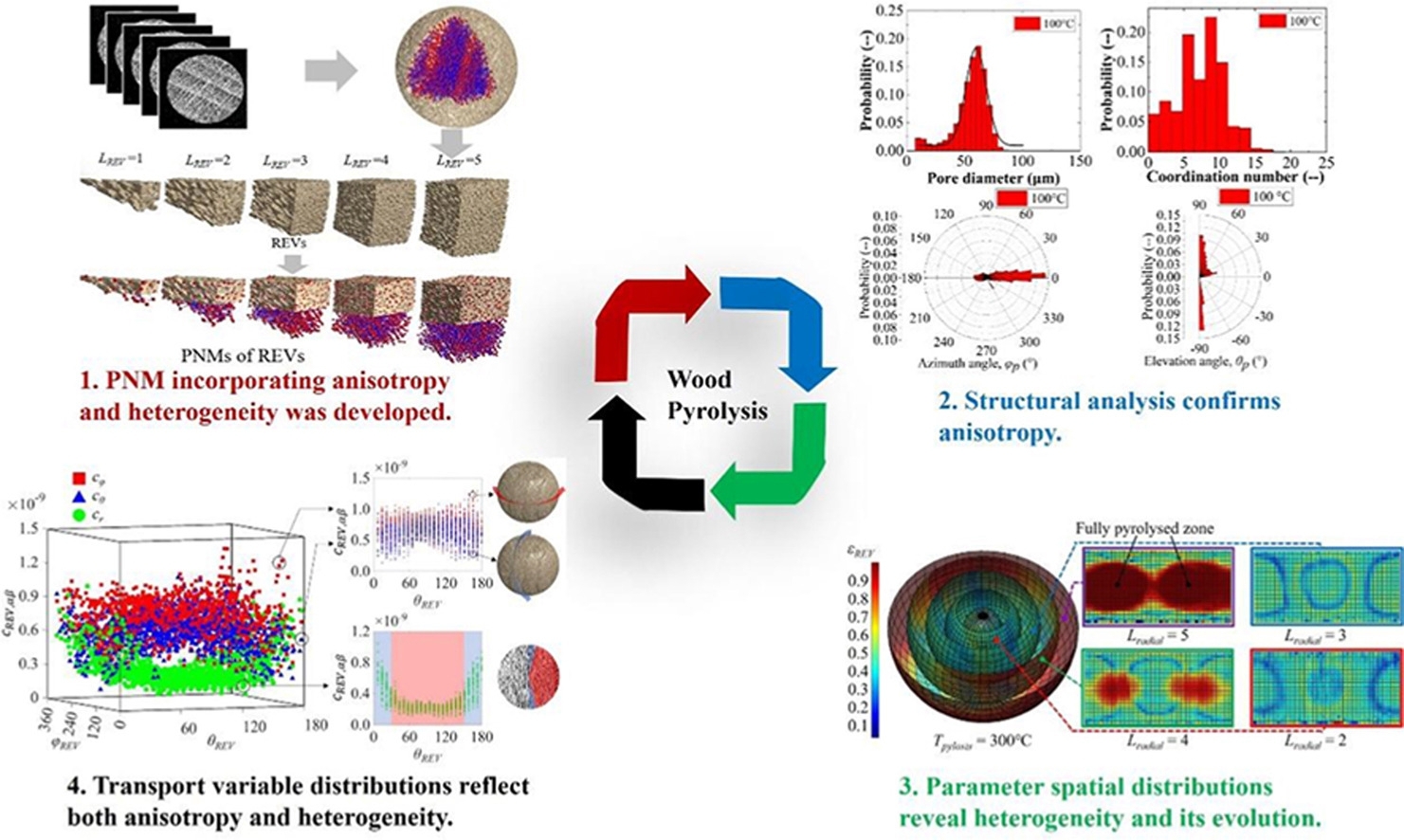
• An OED-based algorithm is applied to extract equivalent pore-network models from high-resolution CT images of beech wood.
• The extracted pore networks explicitly incorporate the anisotropy and heterogeneity of biomass structures.
• Local porosity and permeability are quantified in spherical REV coordinates to reveal spatially varying transport properties.
• REV-scale conductances and product gas volume flow rate enable integration into continuum models.
Abstract
Biomass pyrolysis involves complex structural and transport processes that remain poorly understood at the pore scale. Here, high-resolution image-based reconstruction is integrated with pore network modeling (PNM) to quantify the evolution of pore structure and transport properties in wood particles during staged pyrolysis. The extracted pore networks reveal a contraction–enlargement duality: although particle shrinkage reduces the total number of pores, the remaining pores expand and undergo fracture and coalescence. Orientation analysis further shows a temperature-dependent reduction in structural anisotropy, quantified through the orientation distributions of pore bodies and coordination links. At the representative elementary volume (REV) scale, local porosity and permeability distributions reveal pronounced heterogeneity, while permeability is strongly influenced by pore connectivity and anisotropy. Layer-resolved analyses of wood mass loss and directional conductance demonstrate that pyrolysis progresses radially from the particle surface toward the interior while maintaining anisotropic transport pathways within each layer. The proposed framework establishes a direct link between pyrolysis temperature, pore-scale structural evolution, and transport properties, providing physically informed REV-scale parameters for continuum-scale reactive transport models.
Graphical abstract
Keywords
Anisotropic pores; Biomass; Heterogeneous pore structure; Pyrolysis; Pore morphology evolution; Pore network modeling
文章导读