
期刊文章
过刊浏览
- Volumes 108-119 (2025)
-
Volumes 96-107 (2025)
-
Volume 107
Pages 1-376 (December 2025)
-
Volume 106
Pages 1-336 (November 2025)
-
Volume 105
Pages 1-356 (October 2025)
-
Volume 104
Pages 1-332 (September 2025)
-
Volume 103
Pages 1-314 (August 2025)
-
Volume 102
Pages 1-276 (July 2025)
-
Volume 101
Pages 1-166 (June 2025)
-
Volume 100
Pages 1-256 (May 2025)
-
Volume 99
Pages 1-242 (April 2025)
-
Volume 98
Pages 1-288 (March 2025)
-
Volume 97
Pages 1-256 (February 2025)
-
Volume 96
Pages 1-340 (January 2025)
-
Volume 107
-
Volumes 84-95 (2024)
-
Volume 95
Pages 1-392 (December 2024)
-
Volume 94
Pages 1-400 (November 2024)
-
Volume 93
Pages 1-376 (October 2024)
-
Volume 92
Pages 1-316 (September 2024)
-
Volume 91
Pages 1-378 (August 2024)
-
Volume 90
Pages 1-580 (July 2024)
-
Volume 89
Pages 1-278 (June 2024)
-
Volume 88
Pages 1-350 (May 2024)
-
Volume 87
Pages 1-338 (April 2024)
-
Volume 86
Pages 1-312 (March 2024)
-
Volume 85
Pages 1-334 (February 2024)
-
Volume 84
Pages 1-308 (January 2024)
-
Volume 95
-
Volumes 72-83 (2023)
-
Volume 83
Pages 1-258 (December 2023)
-
Volume 82
Pages 1-204 (November 2023)
-
Volume 81
Pages 1-188 (October 2023)
-
Volume 80
Pages 1-202 (September 2023)
-
Volume 79
Pages 1-172 (August 2023)
-
Volume 78
Pages 1-146 (July 2023)
-
Volume 77
Pages 1-152 (June 2023)
-
Volume 76
Pages 1-176 (May 2023)
-
Volume 75
Pages 1-228 (April 2023)
-
Volume 74
Pages 1-200 (March 2023)
-
Volume 73
Pages 1-138 (February 2023)
-
Volume 72
Pages 1-144 (January 2023)
-
Volume 83
-
Volumes 60-71 (2022)
-
Volume 71
Pages 1-108 (December 2022)
-
Volume 70
Pages 1-106 (November 2022)
-
Volume 69
Pages 1-122 (October 2022)
-
Volume 68
Pages 1-124 (September 2022)
-
Volume 67
Pages 1-102 (August 2022)
-
Volume 66
Pages 1-112 (July 2022)
-
Volume 65
Pages 1-138 (June 2022)
-
Volume 64
Pages 1-186 (May 2022)
-
Volume 63
Pages 1-124 (April 2022)
-
Volume 62
Pages 1-104 (March 2022)
-
Volume 61
Pages 1-120 (February 2022)
-
Volume 60
Pages 1-124 (January 2022)
-
Volume 71
- Volumes 54-59 (2021)
- Volumes 48-53 (2020)
- Volumes 42-47 (2019)
- Volumes 36-41 (2018)
- Volumes 30-35 (2017)
- Volumes 24-29 (2016)
- Volumes 18-23 (2015)
- Volumes 12-17 (2014)
- Volume 11 (2013)
- Volume 10 (2012)
- Volume 9 (2011)
- Volume 8 (2010)
- Volume 7 (2009)
- Volume 6 (2008)
- Volume 5 (2007)
- Volume 4 (2006)
- Volume 3 (2005)
- Volume 2 (2004)
- Volume 1 (2003)
Volume 117
Correlation between hydrate transformation and particle instability during drying of MgCl2 droplets
Jing Liu, Lijuan Zhao, Jiahui Wu, Zhonghua Wu *
School of Mechanical Engineering, Tianjin University of Science and Technology, Tianjin, 300457, China
Volume 117,
October 2026,
Pages 348-364
Received 25 May 2026, Revised 17 July 2026, Accepted 29 July 2026, Available online 30 July 2026, Version of Record 10 August 2026.
E-mail:
wuzhonghua@tust.edu.cn
Highlights
• Drying of MgCl2 droplets couples water removal with phase related reconstruction.
• MgCl2·6H2O evolves through lower hydrates toward hydroxychloride containing solids.
• Morphology deterioration coincides with the hydrate to hydroxychloride transition interval.
• Higher concentration advances instability; higher temperature compresses it.
Abstract
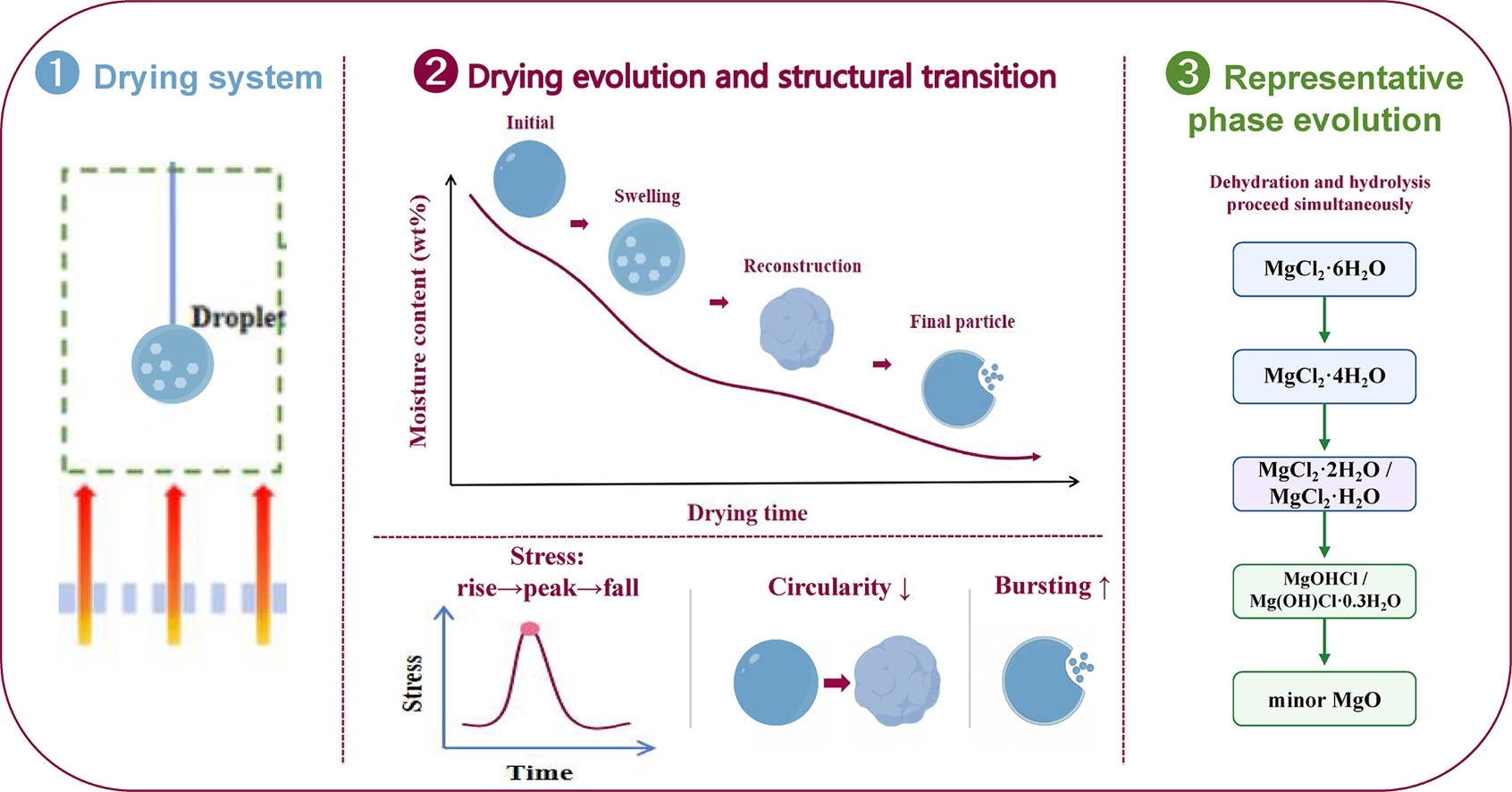
The drying behavior and structural evolution of single magnesium chloride solution droplets were investigated under different initial concentrations, droplet volumes, and drying temperatures. Drying kinetics, morphology, circularity, apparent compressive response, porosity, bursting behavior, and phase evolution were analyzed by image analysis, single particle compression, X-ray diffraction, and infrared spectroscopy. Increasing temperature shortened the average drying time from 183.3 s at 160 °C to 142.2 s at 240 °C, whereas increasing droplet volume from 1 to 3 μL prolonged it from 75.6 s to 300.0 s. Higher temperature and concentration advanced instability and intensified bursting. Under the representative condition of 35.2 wt%, 2 μL, and 200 °C, MgCl2·6H2O dominated at high moisture content, while Mg(OH)Cl became predominant at 15.70–6.57% moisture. This interval coincided with rapid growth in apparent compressive response and intensified bursting. At 30.80% moisture, the increase in lower hydrates and hydroxychloride phases corresponded to drying rate decline and circularity loss. Infrared spectra confirmed that hydroxyl groups and bound water remained in late stage products. The results indicate that droplet deterioration was associated with a hydrate to hydroxychloride reconstruction interval rather than dehydration alone.
Graphical abstract
Keywords
MgCl2 droplet drying; Hydrate transformation; Compressive response evolution; Phase composition analysis; Bursting behavior
文章导读