
期刊文章
-
文章精选
- 当期目录
-
过刊浏览
-
Volumes 108-119 (2025)
-
Volumes 96-107 (2025)
Pages 1-332 (September 2025)
-
Volumes 84-95 (2024)
-
Volumes 72-83 (2023)
-
Volumes 60-71 (2022)
-
Volumes 54-59 (2021)
-
Volumes 48-53 (2020)
-
Volumes 42-47 (2019)
-
Volumes 36-41 (2018)
-
Volumes 30-35 (2017)
-
Volumes 24-29 (2016)
-
Volumes 18-23 (2015)
-
Volumes 12-17 (2014)
-
Volume 11 (2013)
-
Volume 10 (2012)
-
Volume 9 (2011)
-
Volume 8 (2010)
-
Volume 7 (2009)
-
Volume 6 (2008)
-
Volume 5 (2007)
-
Volume 4 (2006)
-
Volume 3 (2005)
-
Volume 2 (2004)
-
Volume 1 (2003)
-
Volumes 108-119 (2025)
-
高被引
-
高下载
-
特邀文章
-
专刊合集
-
待刊文章
高下载
Zhang, J., Qiao, J., Sun, K., & Wang, Z. (2022). Balancing particle properties for practical lithium-ion batteries. Particuology, 61, 18-29. https://doi.org/https://doi.org/10.1016/j.partic.2021.05.006
Balancing particle properties for practical lithium-ion batteries (Open Access)
Jing Zhang, Jinshuo Qiao, Kening Sun, Zhenhua Wang *
Beijing Key Laboratory for Chemical Power Source and Green Catalysis, School of Chemistry and Chemical Engineering, Beijing Institute of Technology, Beijing 100081, China
10.1016/j.partic.2021.05.006
Volume 61,
February 2022,
Pages 18-29
Received 4 February 2021, Revised 6 May 2021, Accepted 15 May 2021, Available online 6 June 2021, Version of Record 27 October 2021.
E-mail:
wangzh@bit.edu.cn
Highlights
• Balancing particle properties is important for practical lithium-ion batteries.
• Small particles can shorten diffusion path and accelerate transfer of Li-ions.
• Uniform particle size distribution reduces polarization in late-stage discharging.
• Single-crystal form without grain boundaries is effective against crack issues.
Abstract
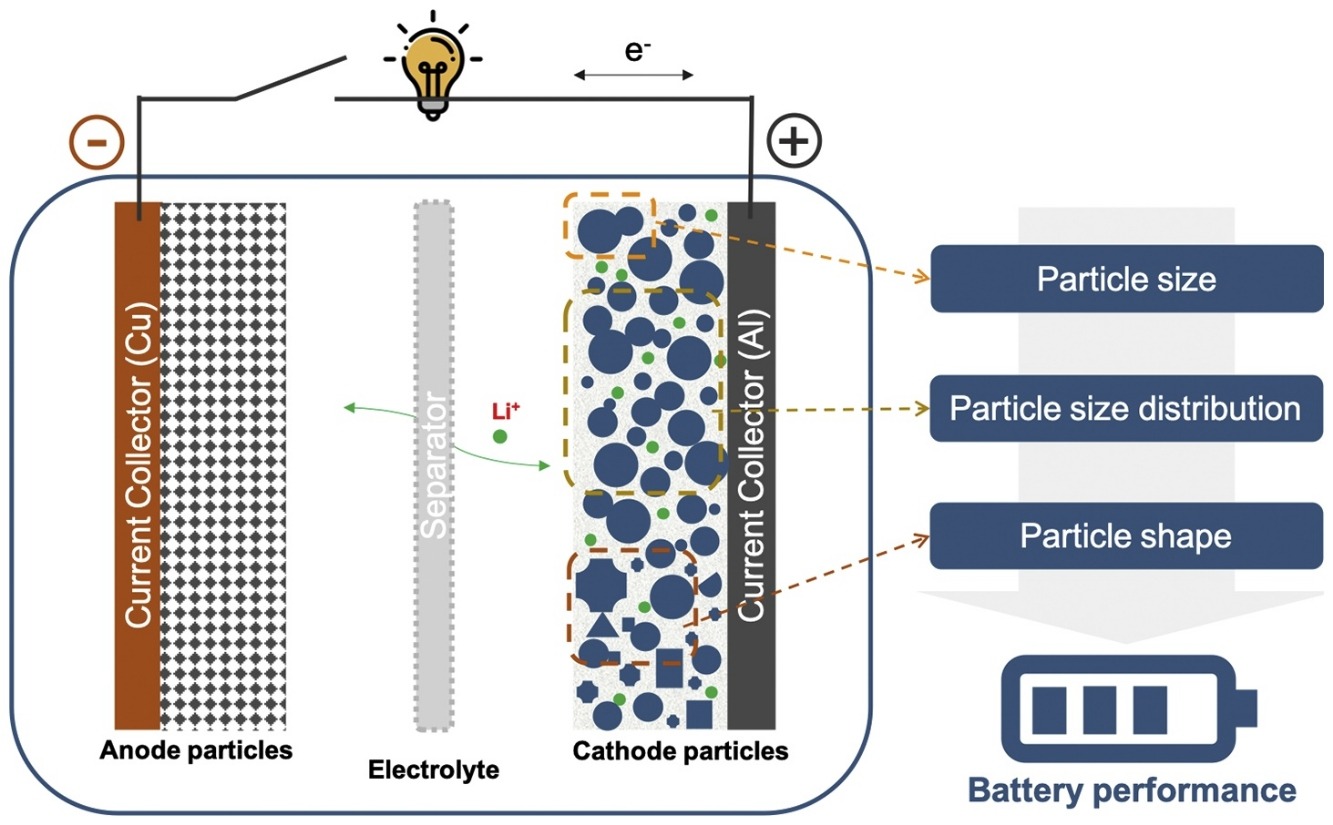
As a state-of-the-art secondary battery,lithium-ion batteries (LIBs) have dominated the consumer electronics market since Sony unveiled the commercial secondary battery with LiCoO2 as the negative electrode material in the early 1990s. The key to the efficient operation of LIBs lies in the effective contact between the Li-ion-rich electrolyte and the active material particles in the electrode. The particle properties of the electrode materials affect the lithium ion diffusion path,diffusion resistance,contact area with the active material, the electrochemical performance and the energy density of batteries. To achieve satisfied comprehensive performance and of LIBs, it is not only necessary to focus on the modification of materials, but also to balance the properties of electrode material particles. Therefore, in this review, we analyze the influence of particle properties on the battery performance from three perspectives: particle size, particle size distribution, and particle shape. A deep understanding of the effect and mechanism of particles on electrodes and batteries will help develop and manufacture practical LIBs.
Graphical abstract
Keywords
文章导读