
期刊文章
-
文章精选
- 当期目录
-
过刊浏览
-
Volumes 108-119 (2025)
-
Volumes 96-107 (2025)
Pages 1-332 (September 2025)
-
Volumes 84-95 (2024)
-
Volumes 72-83 (2023)
-
Volumes 60-71 (2022)
-
Volumes 54-59 (2021)
-
Volumes 48-53 (2020)
-
Volumes 42-47 (2019)
-
Volumes 36-41 (2018)
-
Volumes 30-35 (2017)
-
Volumes 24-29 (2016)
-
Volumes 18-23 (2015)
-
Volumes 12-17 (2014)
-
Volume 11 (2013)
-
Volume 10 (2012)
-
Volume 9 (2011)
-
Volume 8 (2010)
-
Volume 7 (2009)
-
Volume 6 (2008)
-
Volume 5 (2007)
-
Volume 4 (2006)
-
Volume 3 (2005)
-
Volume 2 (2004)
-
Volume 1 (2003)
-
Volumes 108-119 (2025)
-
高被引
-
高下载
-
特邀文章
-
专刊合集
-
待刊文章
高下载
Yao, Y., Xu, J., Huang, Y., & Zhang, T. (2024). Synthesis and applications of carbon nanospheres: A review. Particuology, 87, 325-338. https://doi.org/10.1016/j.partic.2023.09.007
Synthesis and applications of carbon nanospheres: A review (Open Access)
Yaqi Yao a b, Jinming Xu a *, Yanqiang Huang a, Tao Zhang a
a State Key Laboratory of Catalysis, Dalian Institute of Chemical Physics, Chinese Academy of Sciences, Dalian 116023, China
b University of Chinese Academy of Sciences, Beijing 100049, China
10.1016/j.partic.2023.09.007
Volume 87,
April 2024,
Pages 325-338
Received 28 July 2023, Revised 6 September 2023, Accepted 18 September 2023, Available online 26 September 2023, Version of Record 7 November 2023.
E-mail:
xujm@dicp.ac.cn
Highlights
• Progress in the preparation of carbon nanospheres.
• Application of carbon nanospheres in various fields.
• Future development prospect of carbon nanospheres.
Abstract
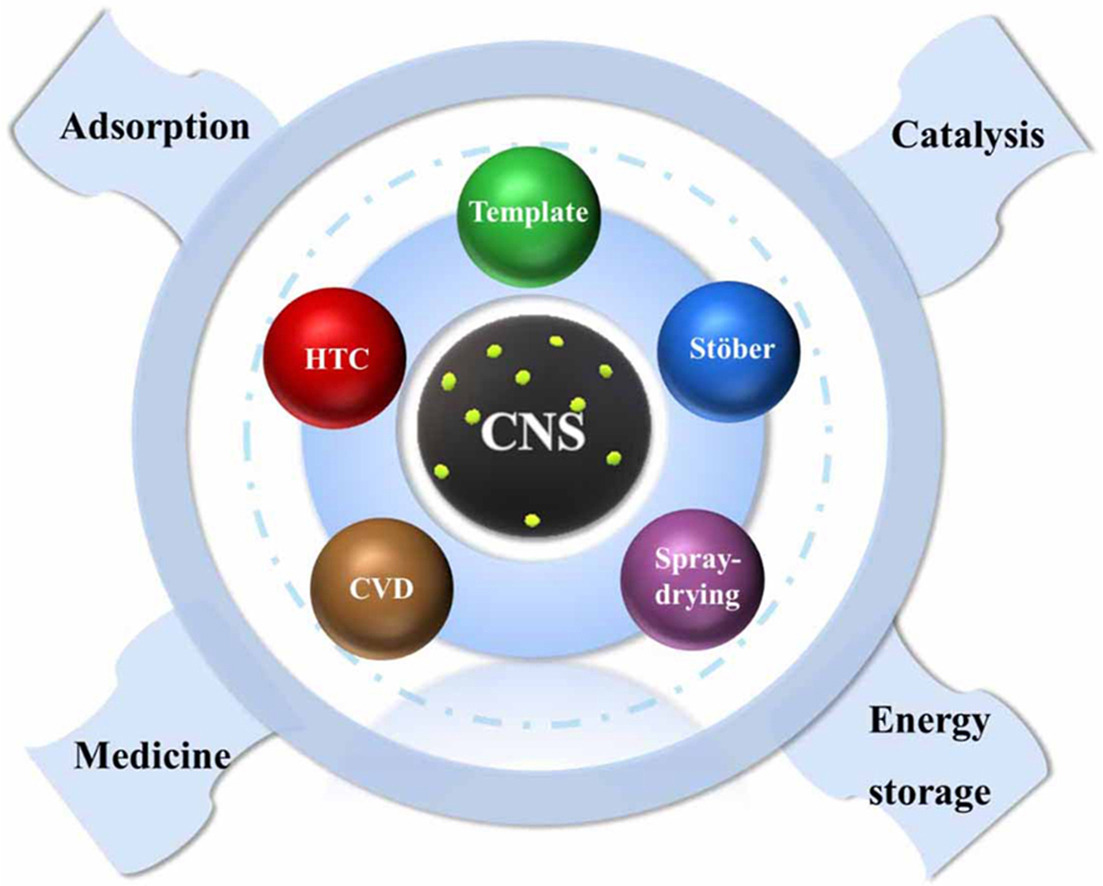
The synthesis of carbon nanospheres (CNS) has developed rapidly in recent years, and they are widely used owing to the tunability of their porous structures and surface properties and the unique hydrodynamic advantages conferred by their spherical structures. This review summarizes the methods used to synthesize CNS and their applications in various fields. The review first describes the four main methods of CNS synthesis, i.e. the template, spray-drying, hydrothermal carbonization, Stöber and chemical vapor deposition method. Next, applications in the fields of energy storage, adsorption, biological medicine, and catalysis are expounded. Finally, some insights on the development and design of CNS are presented.
Graphical abstract
Keywords
Carbon nanosphere; Synthesis; Application
文章导读